Question
Distinguish between ‘general reserve’ and ‘specific reserve’.

Answer

Basis of Difference
General Reserve
Specific Reserve
Meaning
When the reserve is created without any specified purpose, the reserve is called general reserve.
When reserve is created for some specific purpose, the reserve is called specific reserve.
Usage
It can be used for any purpose.
It cannot be used for any purpose other than the specified purpose for which it is created.
Examples
Retained earnings, reserve funds, etc.
Debenture redemption reserve, dividend equalisation reserve, etc.

Need a full question paper?

Generate a complete, print-ready paper with questions like this in minutes — across 16+ boards, with answer keys.

Start Generating Free

Similar questions

“Only financial transactions are recorded in accounting." Explain the statement.
How does the matching concept apply to depreciation?
Prepare an Accounting Equation on the basis of the following transaction:
  1. Started business with cash ₹ 70,000.
  2. Credit purchase of goods ₹ 18,000.
  3. Payment made to creditors in full settlement ₹ 17,500.
  4. Purchase of machinery for cash ₹ 20,000.
  5. Depreciation on machinery ₹ 2,000.
Record the following transactions in the books of Sahdev & Sons assuming all transactions have been entered within the state of Bihar, Charging CGST and SGST @ 9% each.
1.
Bought goods from Nanak Bros. for ₹ 4,00,000 at 10% trade discount and 3% cash discount on purchase price. 25% of the amount paid at the time of purchase.
2.
Sold goods to Kumar & Sons. for ₹ 2,00,000 at 20% trade discount and 5% cash discount on sale price. 60% of the amount received by Cheque.
3.
Received from Gopi Chand ₹ 38,000 by Cheque after deducting 5% cash discount.
4.
Paid ₹ 20,000 for rent by Cheque.
5.
Paid ₹ 50,000 for salaries by Cheque.
6.
Goods worth ₹ 10,000 distributed as free samples.
7.
₹ 5,000 due from Chanderkant are bad-debts.
8.
Sold household furniture for ₹ 15,000 and the proceeds were invested into business.
What will be the effect of the following on the Accounting Equation?
  1. Harish started business with cash ₹ 1,80,000.
  2. Purchased goods for cash ₹ 60,000 and on credit ₹ 30,000.
  3. Sold goods for cash ₹ 40,000; costing ₹ 24,000.
  4. Rent paid ₹ 5,000; and rent outstanding ₹ 2,000.
  5. Sold goods on credit ₹ 50,000 (costing ₹ 38,000).
  6. Salary paid in advance ₹ 3,000.
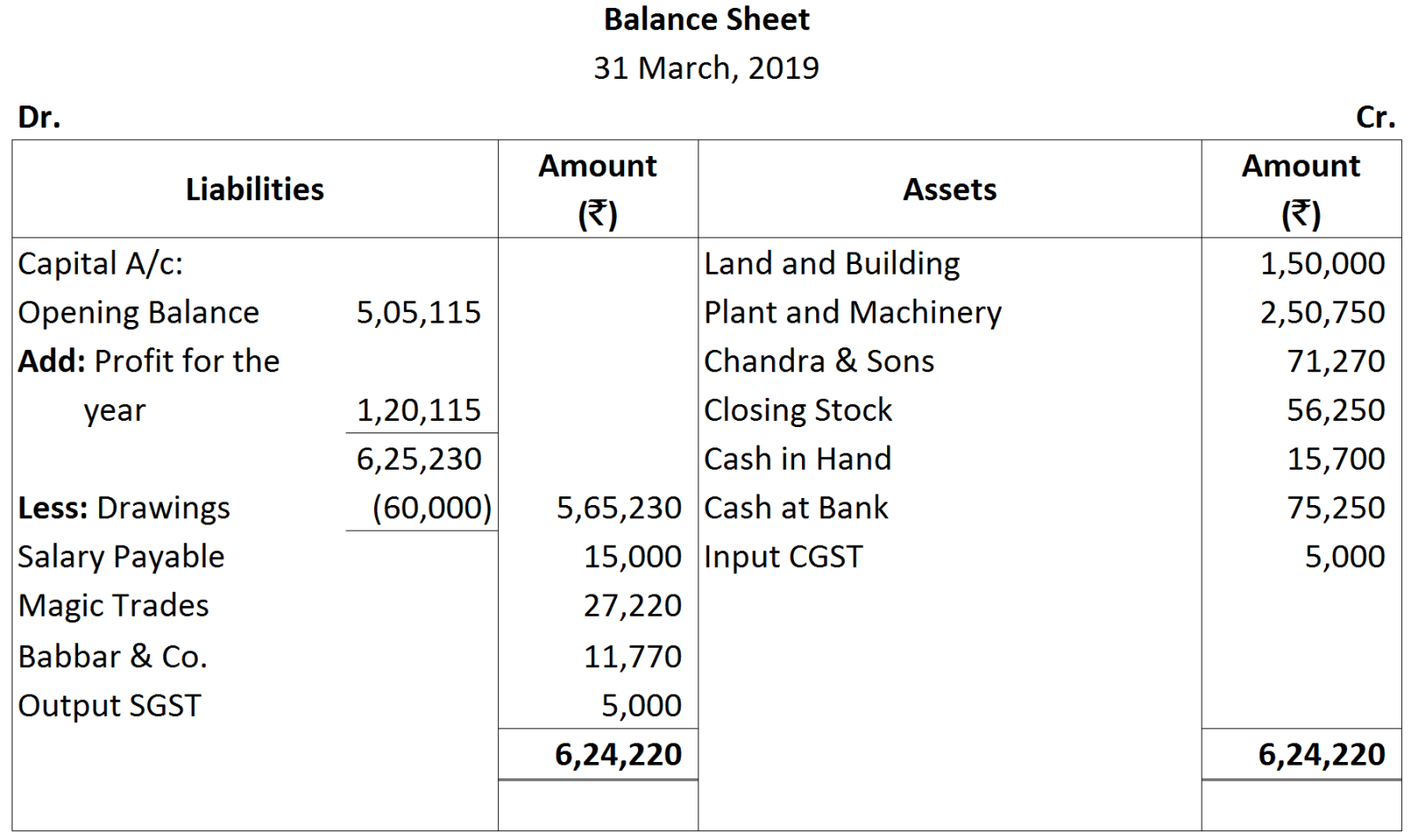
Pass the Opening Entry from the following Balance Sheet as at 31st March, 2019 of Vikas:
Journalise the following transactions in the books of Prakash:
  1. Opened a current account with Punjab National Bank ₹ 1,00,000.
  2. Received a cheque of ₹ 12,900 from Chandradev and allowed discount ₹ 300 to him. The cheque was deposited into Bank on the same day.
  3. Purchased machinery for ₹ 1,00,000, payment made by cheque. Installation charge of machinery ₹ 6,000 paid in cash.
  4. Purchased a horse for business for ₹ 20,000.
  5. Sold goods to Gokul at a list price of ₹ 4,000. Trade discount 10% and cash discount 5%. He paid the amount on the same day and availed the cash discount.
  6. Purchased goods for ₹ 10,000 and paid ₹ 400 for carriage on these goods.
  7. Additional cash introduced by the proprietor ₹ 40,000.
  8. Purchased stationery ₹ 800 and postal stamps ₹ 100.
  9. Withdrawn from bank ₹ 20,000.
  10. Received an order to supply goods of ₹ 40,000 from Manu and received ₹ 10,000 as an advance together with the order.
  11. Cash ₹ 10,000 and goods worth ₹ 4,000 were stolen.
  12. Purchased goods from Devendra for ₹ 40,000 and the payment was made by cheque.
  13. Sold $\frac{1}{4}\text{th}$ of the above goods at a profit of 25% on cash.
Prove that the Accounting Equation is satisfied in all the following transactions of Rajaram. Also prepare a Balance Sheet:
  1. Started business with Cash ₹ 1,20,000.
  2. Purchased a typewriter for Cash for ₹ 8,000 for office use.
  3. Purchased goods for ₹ 50,000 for cash.
  4. Purchased goods for ₹ 40,000 on credit.
  5. Goods costing ₹ 60,000 sold for ₹ 80,000 on credit.
  6. Paid for Rent ₹ 1,500 and for salaries ₹ 2,000.
  7. Received ₹ 800 for Commission.
  8. Withdrew for private use ₹ 5,000 in cash.
Pass entries in the books of Mukerjee & Sons. assuming all transactions have taken place within the state of Uttar Pradesh. Assume CGST @ 9% and SGST @ 9%.
2018
 
March 1
Purchased goods for ₹ 5,00,000 from Mehta Bros.
March 10
Sold goods for ₹ 8,00,000 to Munjal & Co.
March 15
Paid for advertisement ₹ 40,000 by cheque.
March 18
Purchased furniture for office use ₹ 50,000 and payment made by cheque.
March 25
Paid for printing and stationery ₹ 8,000.
March 31
Payment made of balance amount of GST.
Enter the following transactions in Return Outward Book of Modern Furniture House, Udaipur (Rajasthan) assuming CGST @ 6% and SGST @ 6% and post it into Ledger:
2017
 
Nov. 7
Returned to Sachdeva Furniture Store, Ahmedabad (Gujarat):
5 Chairs @ ₹ 2,000 each
1 Table for ₹ 15,000
Less: 10% Trade Discount
Nov. 22
Returned 8 Chairs to India Furniture House, Jodhpur (Rajasthan) @ ₹ 1,500 each, being not of specified quality
Nov. 24
Returned one Dining Table to Arora & Co., Jaipur (Rajasthan) being not according to sample ₹ 50,000
Nov. 28
Allowance claimed from Delhi Furniture Shop, Ahmedabad (Gujarat) on account of mistake in the invoice ₹ 16,000