Question
Distinguish between mechanical and electromagnetic waves.

Answer

Electromagnetic wavesMechanical waves
1. They can travel in vacuum.1. They cannot travel in vacuum. They need a materia I medium for their propagation.
2. These are formed by the periodic vibrations of mutually perpendicular electric and magnetic field in a plane normal to the direction of wave propagation.2. These are formed by the vibrations of the medium particles about their mean positions. These vibrations can be along the direction of propagation of wave or perpendicular to it..
3. These are traverse in nature.3. These waves can be transverse as well as IonqitudnaI.

Need a full question paper?

Generate a complete, print-ready paper with questions like this in minutes — across 16+ boards, with answer keys.
Start Generating Free

Similar questions

Name two main sources of nuclear radiations. How are these radiations harmful?
State the amount of work done by an object when it moves in a circular path for one complete rotation. Give a reason to justify your answer.
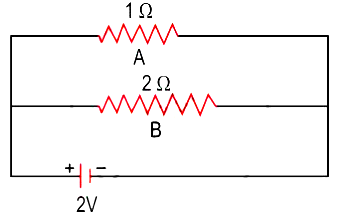
Calculate current flowing through each of the resistors A and B in the circuit shown in following figure?

The resistance of two resistors joined in series is $8 \Omega$ and in parallel is $1.5 \Omega$. Find the value of the two resistances.
What is a magnifying glass (or a simple microscope)? Draw a ray diagram to show how a convex lens may be used as a magnifying glass. Where should the object be placed? State three characteristics of the image formed.
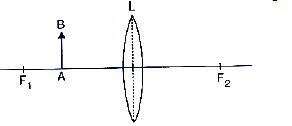
The following diagram shows an object $A B$ and a converging lens $L$ with foci $F_1$ and $F_2$.
Draw two rays from the object and complete the diagram to locate the position of the image. Mark the image $C D$. Clearly mark on the diagram the position of the eye from where the image can be viewed.

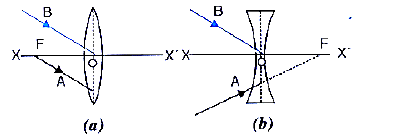
In the diagram below, XX’ represents the principal axis, O the optical centre and F the focus of the lens. Complete the path of rays A and B as they emerge out of the lens.

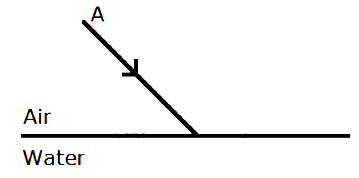
A ray of light from air suffers partial reflection and refraction at the boundary of water.


Complete the diagram showing (i) the reflected ray $B$ and (ii) the refracted ray $C$.
How are the angles of incidence $i$ and refraction $r$ related?
Define the principal focus of a convex lens.
What is optical centre of a thin lens? Draw diagram/diagrams to illustrate it.