Question
Distinguish between: Vasa efferentia and Vasa deferentia.

Answer

Vasa efferentiaVasa deferentia
1. Vasa efferentia arise from the rete testes and enter the epididymis.1. Vasa deferentia arise from the epididymis and form ejaculatory duct after the union with seminal duct.
2. They are present in 15-20 number and are fine convoluted ductules.2. They are thick and coiled ductules present in a single pair.
3. The spermatozoa are carried from rete testis to epididymis by vasa efferentia.3. The spermatozoa are carried from epididymis to ejaculatory ducts by vasa deferentia.

Need a full question paper?

Generate a complete, print-ready paper with questions like this in minutes — across 16+ boards, with answer keys.

Start Generating Free

Similar questions

Column A (Phase of growth)Column B (Condition)
(1) Lag phase(a) Growth rate faster
(2) Log phase(b) Growth rate steady state
(3) Stationary phase(c) Growth rate slow
Natality and Mortality.
Germ line gene therapy and somatic cell gene therapy.
Read the following and answer any four questions from (i) to (v) given below:
During copulation, semen is released by the penis into the vagina. 'The motile sperms swim rapidly, fuse with ovum in the ampullary region, resulting in fertilisation. Haploid nucleus of sperm fuse with that of ovum to form diploid zygote.
  1. In female genital tract, sperms are made capable of fertilising the egg. This phenomenon of sperm activation is called:
  1. Amphimixis.
  2. Cortical reaction.
  3. Capacitation.
  4. Acrosomal reaction.
  1. Select the correct sequence of various physical and chemical events that take place during fertilisation.
  1. Fusion of cortical granules with plasma membrane of secondary oocyte.
  2. Formation of fertilisation cone to receive sperm.
  3. Release of sperm lysin from acrosome.
  4. Mixing up of chromosomes of a sperm and an ovum.
  1. R → Q → P → S
  2. Q → S → R → P
  3. Q → R → S → P
  4. R → P → Q → S
  1. Assertion: Only one sperm can fertilise an ovum.
Reason: The secretion of acrosome help the sperm to enter into cytoplasm of ovum through zona pellucida and plasma membrane.
  1. Both assertion and reason are true, and reason is the correct explanation of assertion.
  2. Both assertion and reason are true, but reason is not the correct explanation of assertion.
  3. Assertion is true, but reason is false.
  4. Both assertion and reason are false
  1. What is the significance of fertilisation?
  1. It restores haploid number of chromosomes.
  2. It produces offspring genetically identical to parents.
  3. It initiates cleavage.
  4. Both (b) and (c).
  1. Site of fertilisation in humans is:
  1. Endometrium of uterine cavity.
  2. Ampullary isthmic junction of oviduct.
  3. Cervix of uterus.
  4. Infundibulum of fallopian tube.
Distinguish between: Graafian follicle and Corpus luteum.
Distinguish between : T. S. of artery and T.S. of vein.
Read the following and answer any four questions from (i) to (v) given below:
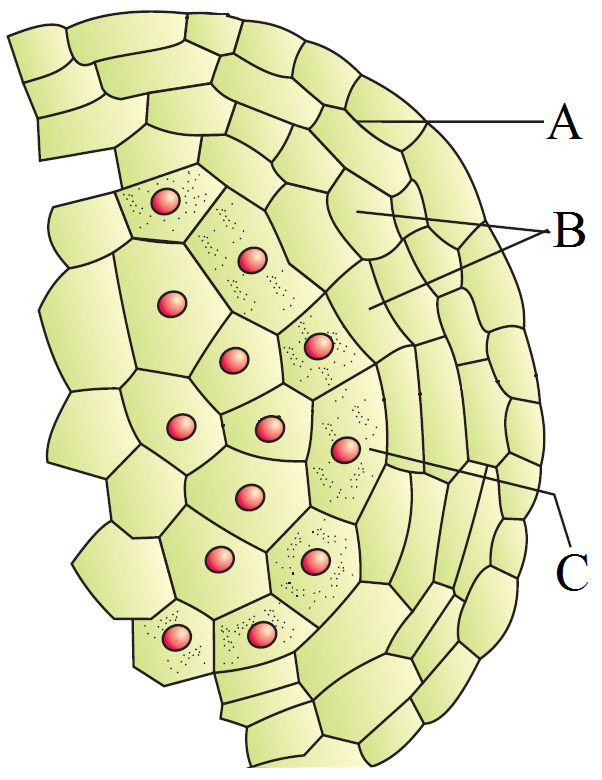
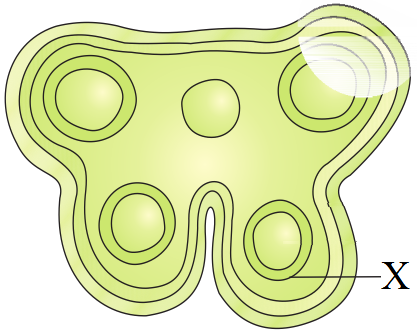
The anther is a four-sided structure consisting of four microsporangia located at the corners, two in each lobe. TI1e microsporangia develop further and become pollen sacs. In a transverse section, a typical microsporangium appears near circular in outline. It is generally surrounded by four wall layers-the epidermis, endothecium, middle layers and the tapetum.
  1. A dithecous another consists of (A) microsporangia, (B) in each lobe.
Select the option that correctly fills the blanks.
S. No
A
B
(a)
Four
Two
(b)
Two
One
(c)
Two
Two
(d)
Four
One
  1. The given diagram shows microsporangium of a mature anther. Identify A, B and C.
(a)
A-Middle layer
B-Endothecium
C-Tapetum
(b)
A-Endothecium
B-Tapetum
C- Middle layer
(c)
A-Endothecium
B-Middle layer
C-Tapetum
(d)
A-Tapetum
B-Middle layer
C-Endothecium
  1. The function of labelled part X is:
  1. Dehiscence.
  2. Mechanical.
  3. Nutrition.
  4. Protection.
  1. Select the incorrect statement.
  1. Microsporangium is generally surrounded by four wall layers-epidermis, endothecium, middle layers and tapetum.
  2. Outer three layers perform functions of protection and dehiscence of anthers.
  3. Cells of tapetum possess dense cytoplasm and generally have more than one nucleus.
  4. Cells of tapetum undergo meiosis and produce microspore tetrads.
  1. Which function oftapetum is correct?
  1. Helps in pollen wall formation.
  2. Transportation of nutrients to inner side of another.
  3. Synthesis of callase enzyme for separation of microspore tetrads.
  4. All of these.
Read the following and answer any four questions from (i) to (v) given below:
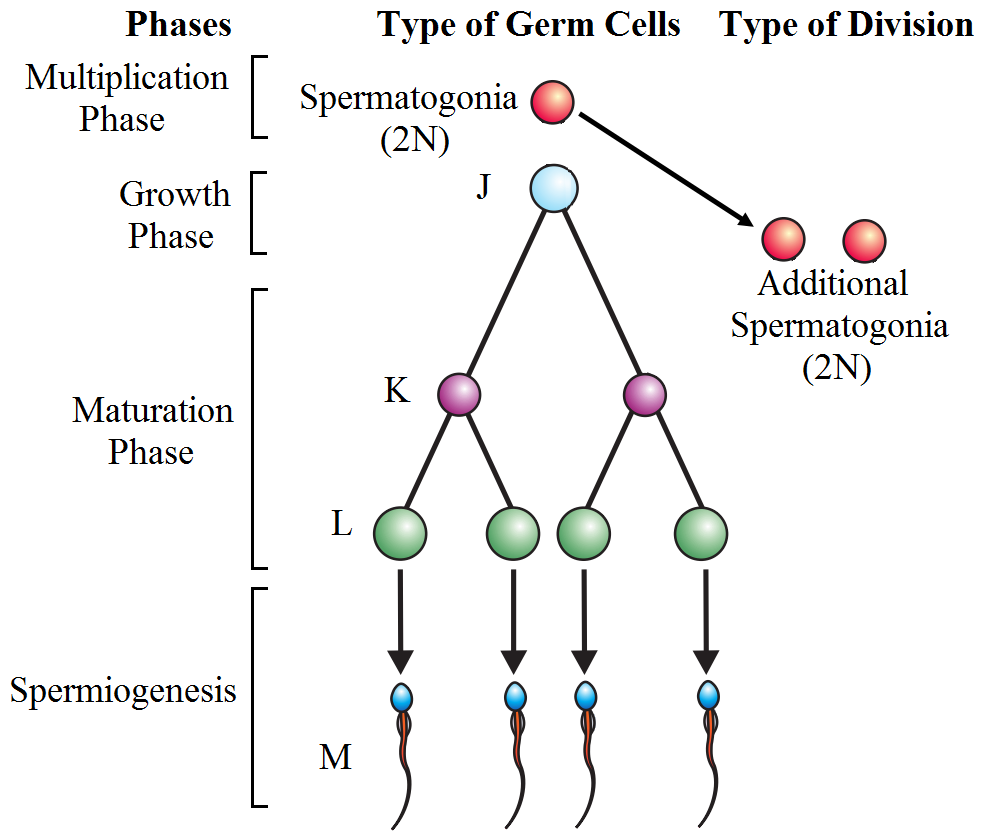
In testis, the immature male germ cells produce sperms by spermatogenesis that begins at puberty. It occurs in the seminiferous tubules of the testes. Seminiferous tubules are lined by germinal epithelium. Study the schematic representation of spermatogenesis and answer the following questions.
  1. Which cell division occurs during multiplication phase?
  1. Mitosis.
  2. Meiosis I.
  3. Meiosis II.
  4. Both (b) and (c).
  1. How many chromosomes are present in secondary spermatocyte and spermatid, respectively?
  1. 46, 23
  2. 46, 46
  3. 23, 23
  4. 23, XY
  1. Transformation of L into M is known as:
  1. Spermiation.
  2. Spermateliosis.
  3. Spermatogenesis.
  4. None of these.
  1. Select the correct option.
  1. Type A spermatogonia grows to larger primary spermatocyte.
  2. One spermatogonium forms two spermatids.
  3. Spenniation is the release of sperms from seminiferous tubules.
  4. Primary spermatocyte undergoes mitosis to form secondary spermatocytes.
  1. Which hormone acts on spermatogonia to stimulate sperm production?
  1. LH.
  2. GnRH.
  3. ABP.
  4. FSH.
Read the following and answer any four questions from (i) to (v) given below:
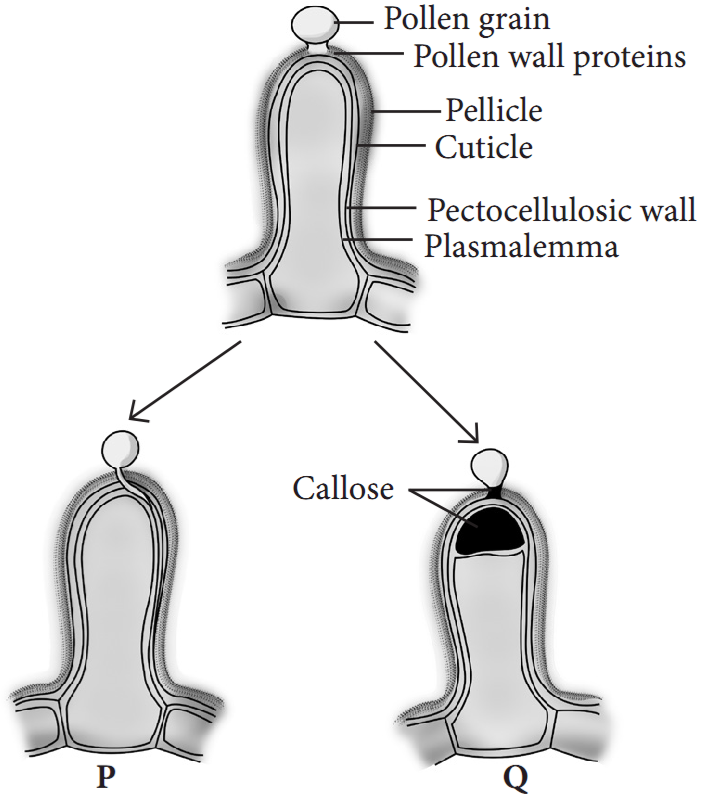
Pollen-pistil interaction is the group of events that occur from the time of pollen deposition over the stigma to the time of pollen tube entry into ovule. It is a dynamic process which has checks at several places for promotion or inhibition of pollen growth. Pollen-pistil interaction is a safety measure to ensure that illegitimate crossings do not occur. Compatibility and incompatibility of the pollen-pistil is determined by special proteins. The compatible pollens are able to absorb water and nutrients from the surface of the stigma. They germinate and produce pollen tubes. Pollen tubes grow into the style. Their growth and path through the style are also determined by specific chemicals.
  1. Which of the following parts of gynoecium determines the compatible nature of pollen?
  1. Stigma.
  2. Style.
  3. Ovary.
  4. Thalamus.
  1. In Triforium, which type of self-incompatibility is found?
  1. Gametophytic self-incompatibility (GSI).
  2. Sporophytic self-incompatibility (SSI).
  3. Both GSI and SSI.
  4. None of these.
  1. Select the incorrect statement.
  1. In Asteraceae, incompatibility is due to the genotype of the sporophytic stigmatic tissues.
  2. In members of Brassicaceae, incompatibility is due to the genotype of the pollen.
  3. Nature has imposed self-incompatibility to avoid highly homozygous individuals, which have a very low survival value.
  4. None of these.
  1. Which of the following are examples of self incompatibility?
  1. Tobacco.
  2. Potato.
  3. Crucifers.
  4. All of these.
  1. Given figures show the pollen-stigma interaction, where pollen wall proteins are released onto the pellicle of stigmatic papillae, where a recognition reaction occurs.


Which of the following statements drawn from given figures is incorrect?
  1. P indicates compatible reaction in which the pollen tube penetrates the cuticle and grows down the papilla.
  2. Development of callose plug between the plasma membrane and pectocellulosic layer of stigmatic papillae results in the incompatibility reaction in Q.
  3. A callose plug, which appears at the tip of pollen in Q, is dissolved by callase enzyme secreted by stigma resulting in compatibility reaction.
  4. Deposition of callose can be employed as a reliable bioassay to detect compatibility or incompatibility reactions of pollen and stigma.
Read the following and answer any four questions from (i) to (v) given below:
Ginkgo tree has been saved from extinction by selective breeding followed by channeling into trade of nature lovers. This is an ex-situ conservation, where endangered species are protected from all adverse factors. Offspring produced in captive breeding are released in natural habitat for acclimatisation.
  1. What is the significance of offsite collections?
  1. Restock depleted populations.
  2. Protection of endangered species.
  3. Reintroduce species in wild.
  4. All of these.
  1. Which of the following is not an ex-situ conservation?
  1. Wetlands
  2. Orchards
  3. Aquaria
  4. Botanical gardens.
  1. Select the incorrect statements for ex-situ conservation.
  1. It is conservation of species outside their natural habitats.
  2. Endangered species are kept under human supervision and provided all the essentials.
  3. The species population recovers in natural environment.
  4. Both (b) and (c).
  1. Conditions maintained in seed banks for orthodox seeds are:
  1. Low moisture content.
  2. Anaerobic conditions.
  3. Low temperature.
  4. All of these.
  1. Assertion: Animal species which have become extinct in wild continue to be maintained in zoological parks.
Reason: Captive breeding is the conservation of those cases where these is no realistic chance of in-situ survival.
  1. Both assertion and reason are true and reason is the correct explanation of assertion.
  2. Both assertion and reason are true but reason is not the correct explanation of assertion.
  3. Assertion is true but reason is false.
  4. Both assertion and reason are false.