MCQ
$\frac{{{d^2}x}}{{d{y^2}}} = $
  • A
    $ - {\left( {\frac{{{d^2}y}}{{d{x^2}}}} \right)^{ - 1}}{\left( {\frac{{dy}}{{dx}}} \right)^{ - 3}}$
  • B
    $\;\left( {\frac{{{d^2}y}}{{d{x^2}}}} \right){\left( {\frac{{dy}}{{dx}}} \right)^{ - 2}}$
  • $ - \left( {\frac{{{d^2}y}}{{d{x^2}}}} \right){\left( {\frac{{dy}}{{dx}}} \right)^{ - 3}}$
  • D
    $\;{\left( {\frac{{{d^2}y}}{{d{x^2}}}} \right)^{ - 1}}$
Answer

Correct option: C.
$ - \left( {\frac{{{d^2}y}}{{d{x^2}}}} \right){\left( {\frac{{dy}}{{dx}}} \right)^{ - 3}}$
c
$\frac{{{d^2}x}}{{d{y^2}}} = \frac{d}{{dy}}\left( {\frac{{dx}}{{dy}}} \right) = \frac{d}{{dy}}\left( {\frac{1}{{\frac{{dy}}{{dx}}}}} \right)$

$ = \frac{d}{{dx}}\left( {\frac{1}{{\frac{{dy}}{{dx}}}}} \right) \cdot \frac{{dx}}{{dy}} =  - \frac{1}{{{{\left( {\frac{{dy}}{{dx}}} \right)}^2}}} \cdot \frac{{{d^2}y}}{{d{x^2}}} \cdot \frac{1}{{\left( {\frac{{dy}}{{dx}}} \right)}}$

$=-\frac{1}{\left(\frac{d y}{d x}\right)^{3}} \cdot \frac{d^{2} y}{d x^{2}}=-\left(\frac{d y}{d x}\right)^{-3}\left(\frac{d^{2} y}{d x^{2}}\right) $

Need a full question paper?

Generate a complete, print-ready paper with questions like this in minutes — across 16+ boards, with answer keys.

Start Generating Free

Similar questions

If $g\left( x \right) = \mathop \smallint \limits_0^x \cos 4t\;dt$ then $g\left( {x + \pi } \right) = $
If $A = \left[ {\begin{array}{*{20}{c}}0&1\\0&0\end{array}} \right],I$ is the unit matrix of order $2$ and $a, b$ are arbitrary constants, then ${(aI + bA)^2}$ is equal to
If $f\left( x \right) = \left[ x \right] - \left[ {\frac{x}{4}} \right],\,x \in R$ , where $[x]$ denotes the greatest integer function, then
$D$ is a $3 \times 3$ diagonal matrix. Which of the following statements is not true?
The value of $\int\limits_0^{\frac{\pi }{2}} {\sin \,8x\,\cot\, xdx\, + \int\limits_{ - \frac{\pi }{4}}^{\frac{\pi }{4}} {\ln \left( {\frac{{1 - \sin \,x}}{{1 + \sin \,x}}} \right)dx} } $ is equal to
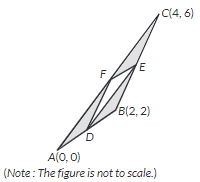
The points $D, E$ and $F$ are the mid-points of $A B, B C$ and $C A$ respectively.
Image
What is the area of the shaded region?
A line $'l'$ passing through origin is perpendicular to the lines  $l_{1}: \overrightarrow{ r }=(3+ t ) \hat{ i }+(-1+2 t ) \hat{ j }+(4+2 t ) \hat{ k }$ ; $l_{2}: \overrightarrow{ r }=(3+2 s ) \hat{ i }+(3+2 s ) \hat{ j }+(2+ s ) \hat{ k }$ . If the co-ordinates of the point in the first octant on ${ }^{\prime} l_{2}^{\prime}$ at a distance of $\sqrt{17}$ from the point of intersection of $^{\prime} l^{\prime}$ and ${ }^{\prime} l_{1}^{\prime}$ are $( a , b , c ),$ then $18( a+ b + c )$ is equal to ........ .
If $f(x) = \cos x\cos 2x\cos 4x\cos 8x\cos 16x$, then $f'\left( {{\pi \over 4}} \right)$ is
If $f(x) = \cos \left( {{{\tan }^{ - 1}}\left( {\sin \left( {{{\cos }^{ - 1}}x} \right)} \right)} \right) + \sin \left( {{{\cot }^{ - 1}}\left( {\cos \left( {{{\sin }^{ - 1}}x} \right)} \right)} \right)$ has range $\left[ {m,M),} \right.$ then number of solutions of the equation $\operatorname{sgn} \left( {\left| {x - 1} \right| - 2} \right) = \ln \left| {x - 2} \right|$ is (where sgn denotes signum function)
The matrix $\text{A}=\begin{bmatrix}1&0&0\\0&2&0\\0&0&4\end{bmatrix}$ is:
  1. Identity matrix.
  2. Symmetric matrix.
  3. Skew-symmetric matrix.
  4. Diagonal matrix.