Question
Divide : $10 m n^2-15 m^2 n^2+5 m^3 n$ by $-5 m n$

Answer

$-2 n+3 m n-m^2$

Need a full question paper?

Generate a complete, print-ready paper with questions like this in minutes — across 16+ boards, with answer keys.
Start Generating Free

Similar questions

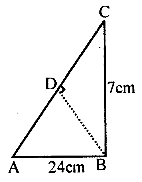
Use the information given in the adjoining figure to find : $(i)$ the length of $AC.(ii)$ the area of an $\triangle ABC\ (iii)$ the length of $BD$, correct to one decimal place.
Find the sum of exterior angle obtained on producing, in order, the side of a polygon with $: 7$ sides
Factorise : $4(2a + b)^2 - (a - b)^2$
Divide : $\left(12 x^2+11 x+2\right)$ by $(4 x+1)$
A man completed a trip of $136\  km$ in $8$ hours. Some part of the trip was covered at $15\  km/hr$ and the remaining at $18\  km/hr$. Find the part of the trip covered at $18\  km/hr.$
In an Isosceles$-$trapezium, show that the opposite angles are supplementary.
If $\sqrt{784}=28$, find the value of: $\sqrt{0.0784}+\sqrt{0.000784}$
Four friends studying in different schools sat down to discuss their scores in their mid-term examinations. Their scores are as under :
(i) A secured 56 marks out of 80 . $\quad$ (ii) B secured 108 marks out of 150 .
(iii) C secured 51 marks out of 75 . $\quad$ (iv) D secured 87 marks out of 120 .
1. Which of the four friends had the best performance?
(a) A $\quad$(b) B $\quad$(c) C $\quad$(d) D

2. C got his test paper re-evaluated and his score increased by $12 \%$. His new score is :
(a) 56 $\quad$(b) $57 \cdot 5$ $\quad$(c) 58 $\quad$(d) 60

3. If the pass percentage in A's test was $40 \%$, how many percent more marks did he obtain than the passing marks ?
(a) $32 \%$ $\quad$(b) $40 \%$ $\quad$(c) $60 \%$ $\quad$(d) $75 \%$

4. If D obtained 45 marks more than the passing marks, then what was the pass percentage in his test?
(a) $34 \%$ $\quad$(b) $35 \%$ $\quad$(c) $38 \%$ $\quad$(d) $40 \%$
The diameter of a wheel is $0.70\  m$. Find the distance covered by it in $500$ revolutions. If the wheel takes $5$ minutes to make $500$ revolutions; find its speed in : $(i)\  m/s\ (ii)\  km/hr.$
Use the direct method to evaluate the following products : $(y + 5)(y – 3)$