Question
Do all the thermocouples have a neutral temperature?

Answer

As neutral temperature is The temperature of the hot junction of a thermocouple at which the electromotive force of the thermocouple attains its maximum value, when the cold junction is maintained at a constant temperature of 0°C.
So, answer is yes.

Need a full question paper?

Generate a complete, print-ready paper with questions like this in minutes — across 16+ boards, with answer keys.
Start Generating Free

Similar questions

Explain, with the help of a circuit diagram, the working of a photo-diode. Write briefly how it is used to detect the optical signals.
A hydrogen atom in state n = 6 makes two successive transitions and reaches the ground state. In the first transition a photon of 1.13eV is emitted. (a) Find the energy of the photon emitted in the second transition (b) What is the value of n in the intermediate state?
Are matter waves electromagnetic?
Explain Electro static potential energy.
In an accelerator experiment on high-energy collisions of electrons with positrons, a certain event is interpreted as annihilation of an electron-positron pair of total energy 10.2 BeV into two γ-rays of equal energy. What is the wavelength associated with each γ-ray? (1BeV = 109 eV).
  1. Describe briefly three experimentally observed features in the phenomenon of photoelectric effect. 
  2. Discuss briefly how wave theory of light cannot explain these features.
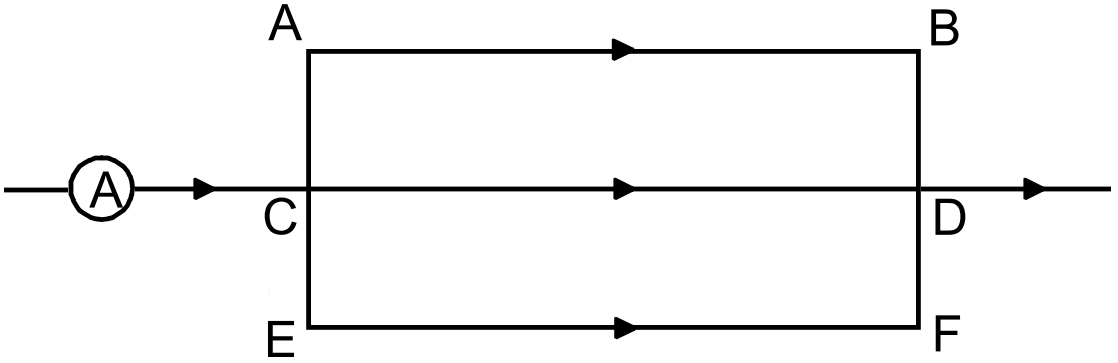
Figure shows a part of an electric circuit. The wires AB, CD and EF are long and have identical resistances. The separation between the neighbouring wires is 1.0cm. The wires AE and BF have negligible resistance and the ammeter reads 30A. Calculate the magnetic force per unit length of AB and CD.

Two small bodies of masses 2.00kg and 4.00kg are kept at rest at a separation of 2.0m. Where should a particle of mass 0.10kg be placed to experience no net gravitational force from these bodies? The particle is placed at this point. What is the gravitational potential energy of the system of three particles with usual reference level?
Explain, with the help of a nuclear reaction in each of the following cases, how the neutron to proton ratio changes during (i) alpha-decay (ii) beta-decay?
Define the terms ‘stopping potential’ and ‘threshold frequency’ in relation to photoelectric effect. How does one determine these physical quantities using Einstein’s equation?