Question
Do electrons try to move to a higher potential region or a lower potential region, why?

Answer

Electrons try to move to higher potential regions because they are negatively charged.

Need a full question paper?

Generate a complete, print-ready paper with questions like this in minutes — across 16+ boards, with answer keys.
Start Generating Free

Similar questions

Write the importance of Huygens principle. What are the two assumptions of this theory?
The magnetic moment vectors $\mu_\text{s}$ and $\mu_\text{l}$ associated with the intrinsic spin angular momentum S and orbital angular momentum l, respectively, of an electron are predicted by quantum theory (and verified experimentally to a high accuracy) to be given by:
$\mu_\text{s}=-(\text{e}/\text{m})\text{S}.$
$\mu_\text{l}=-(\text{e}/2\text{m})\text{l}.$
Which of these relations is in accordance with the result expected classically? Outline the derivation of the classical result.
The magnitude of linear momentum of a particle moving at a relativistic speed v is proportional to:
  1. $\text{v}$
  2. $\sqrt{1-\frac{\text{v}^2}{\text{c}^2}}$
  3. $1-\frac{\text{v}^2}{\text{c}^2}$
  4. None of these.
Water flows at a speed of 6cm/s through a tube of radius 1cm. Coefficient of viscosity of water at room termperature is 0.01 poise. Calculate the Reynolds number. Is it a steady flow?
An incomplete sentence about transistors is given below:
The emitter ...... junction is ....... and the collector ..... junction is ..... The appropriate words for the dotted empty positions are, respectively.
  1. 'Collector' and 'base'.
  2. 'Base' and 'emitter'.
  3. 'Collector' and 'emitter'.
  4. 'Base' and 'base'.
Why is the use of a.c. voltage preferred over d.c. voltage? Give two reasons.
When a p-type impurity is doped in a semiconductor, a large number of holes are created. This does not make the semiconductor charged. But when holes diffluse from the p-side to the n-side in a p-n junction, the n-side gets positively charged. Explain.
Answer the following question:
A charged particle enters an environment of a strong and non-uniform magnetic field varying from point to point both in magnitude and direction, and comes out of it following a complicated trajectory. Would its final speed equal the initial speed if it suffered no collisions with the environment?
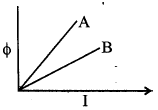
A plot of magnetic flux ($\Phi$) versus current (I) is shown in the figure for two inductors A and B. Which of the two has larger value of self inductance?

Define the term self-inductance of a solenoid. Obtain the expression for the magnetic energy stored in an inductor of self-inductance L to build up a current I through it.