Question
Do magnetic forces obey Newton's third law. Verify for two current elements $\text{dI}_1=\text{dI}\hat{\text{i}}$ located at the origin and $\text{dI}_2=\text{dI}\hat{\text{j}}$ located at $(0, R, 0)$. Both carry current $I.$

Answer

Key concept: In this problem first we have to find the direction of magnetic field due to one wire at the point on other wire, then the magnetic force on that current carrying wire.
According to Biot$-$Savart's law, magnetic field $B$ is parallel to $idl \times r$ and $idl$ is the current carrying element having it's direction along the direction of flow of current.
Here, for the direction of magnetic field, at $dl_2$, located at $(0, R, 0)$ due to wire dlx is given by $B \| idl \times r$ or $i \times j ($because point $(0, R, 0)$ lies ony$-$axis$)$, but $i \times j = k$.
So, the direction of magnetic field at $dl_2$ is along $z-$direction.
The direction of magnetic force exerted at $dl_2$ due to the magnetic field of first wire is along the $x-$axis.
$F - i(l \times B),$ i.e., $F \| (i \times k)$ or along $-j$ direction.
Therefore, force due to dl $[$on $dl_2$ is non$-$zero.$]$
Now, for the direction of magnetic field, at $dx$, located at $(0, 0, 0)$ due to wire $d_2$ is given by $B \| idl \times r$ or $j \times -j ($because origin lies on $y-$direction $w.r.t$. point $(0, R, 0)$, but $j \times -j = 0.$
So, the magnetic field at dx does not exist.
Force due to $dl_2$ on $dl_1$, is zero.
So, magnetic forces do not obey Newton's third law. But they obey Newton's third law if current carrying element are placed parallel to each other.

Need a full question paper?

Generate a complete, print-ready paper with questions like this in minutes — across 16+ boards, with answer keys.
Start Generating Free

Similar questions

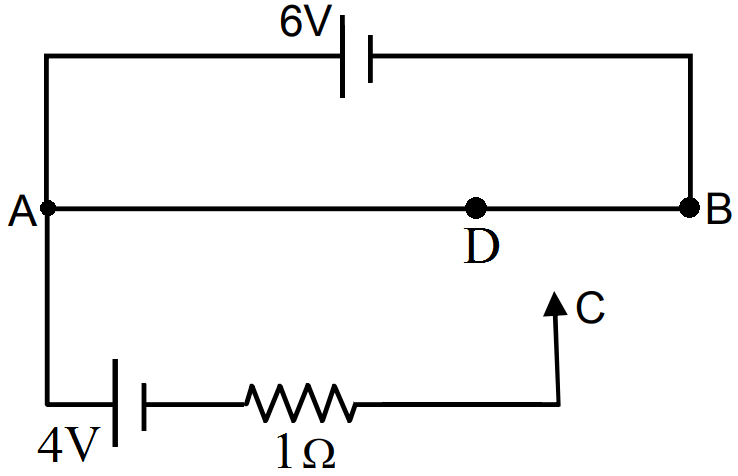
A $6$ volt battery of negligible internal resistance is connected across a uniform wire $AB$ of length $100\ cm.$ The positive terminal of another battery of emf $4V$ and internal resistance $1\Omega$ is joined to the point $A$, as shown in the figure. Take the potential at $B$ to be zero.
$(a)$ What are the potentials at the points $A$ and $C$?
$(b)$ At which point $D$ of the wire $AB$, the potential is equal to the potential at $C$?
$(c)$ If the points $C$ and $D$ are connected by a wire, what will be the current through it?
$(d)$ If the $4V$ battery is replaced by a $7.5V$ battery, what would be the answers of parts $(a)$ and $(b)$?
Let there be $n$ resistors $R_1............R_n$ with $R_\text{max} = \max \ (R_1......... R_n)$ and $R_\text{min} = \min {R_1 ..... R_n}$. Show that when they are connected in parallel, the resultant resistance $R_P < R_\text{min}$ and when they are connected in series, the resultant resistance $R_S > R_\text{max}$. Interpret the result physically.
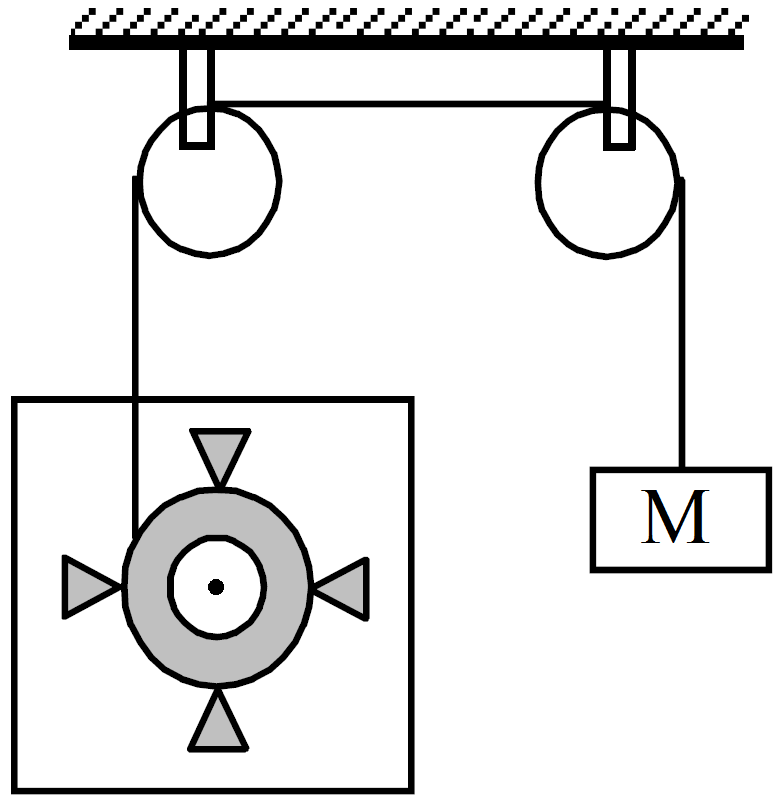
Figure, shows water in a container having $2.0\ mm$ thick walls made of a material of thermal conductivity $0.50\text{Wm}^{-1}{^{\circ}}\text{C}^{-1}.$ The container is kept in a melting$-$ice bath at $0^\circ C.$ The total surface area in contact with water is $0.05m^2.$ A wheel is clamped inside the water and is coupled to a block of mass $M$ as shown in the figure. As the block goes down, the wheel rotates. It is found that after some time a steady state is reached in which the block goes down with a constant speed of $10\ cms^{-1}$ and the temperature of the water remains constant at $1.0^\circ C.$ Find the mass $M$ of the block. Assume that the heat flows out of the water only through the walls in contact. Take $g = 10\ ms^{-2}.$
  1. With the help of a labelled diagram, explain the working of a step $-$ up transformer. Give reasons to explain the following:
  1. Find:
  2. External force required to move the rod with uniform velocity $v = 10\ cm/ s,$
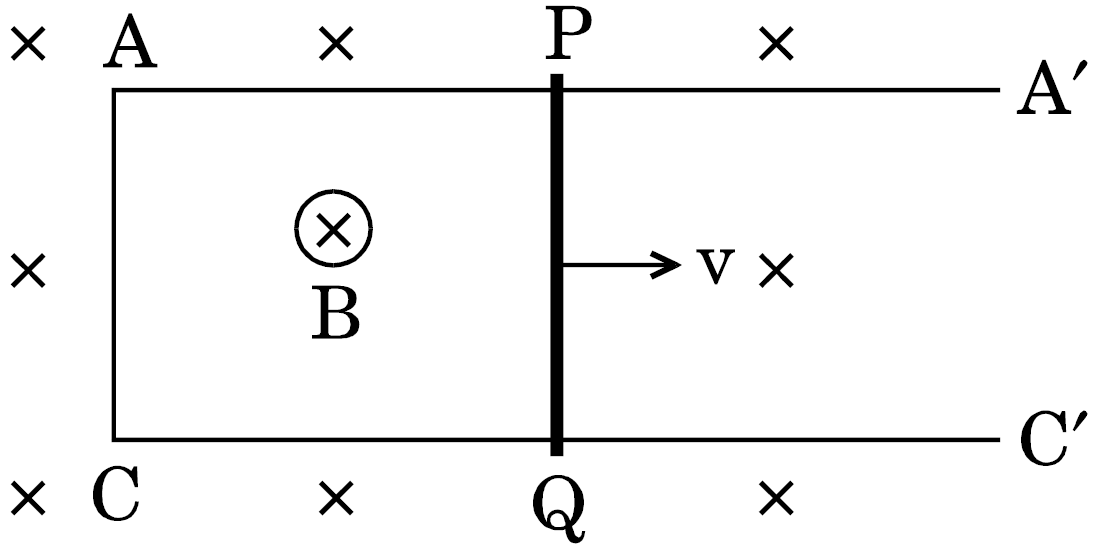
  3. A conducting rod $PQ$ of length $20\ cm$ and resistance $0.1\Omega$ rests on two smooth parallel rails of negligible resistance $AA\ '$ and $CC\ '.$ It can slide on the rails and the arrangement is positioned between the poles of a permanent magnet producing uniform magnetic field $B = 0.4T$. The rails, the rod and the magnetic field are in three mutually perpendicular directions as shown in the figure. If the ends $A$ and $C$ of the rails are short circuited,
  4. The core of the transformer is laminated.
  5. Thick copper wire is used in windings.
  6. Power required to do so.
The earth revolves round the sun due to gravitational attraction. Suppose that the sun and the earth are point particles with their existing masses and that Bohr's quantization rule for angular momentum is valid in the case of gravitation.
(a) Calculate the minimum radius the earth can have for its orbit.
(b) What is the value of the principal quantum number n for the present radius? Mass of the earth $= 6.0 \times 10^{-24}kg.$ Mass of the sun $= 2.0 \times 10^{30}kg,$ earth $-$ sun distance $= 1.5 \times 10^{11}m$.
Find the value of $\frac{\text{t}}{\tau}$ for which the current in an LR circuit builds up to:
  1. 90%,
  2. 99%
  3. 99·9% of the steady-state value.
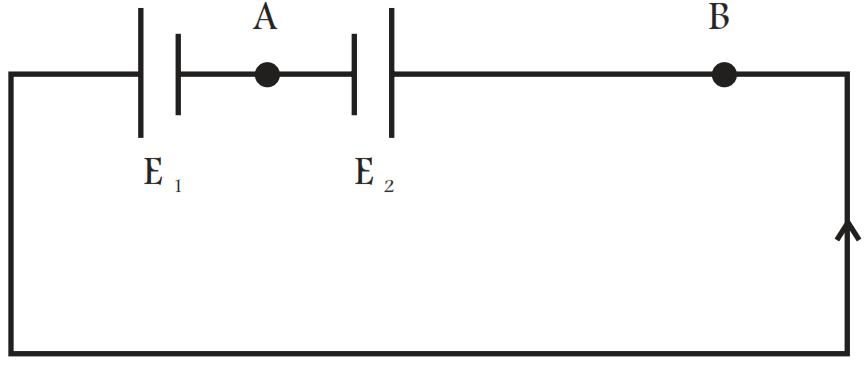
The circuit in Fig. shows two cells connected in opposition to each other. Cell $E_1$ is of emf $6V$ and internal resistance $2\Omega$ ; the cell $E_2$ is of emf $4V$ and internal resistance $8\Omega$ . Find the potential difference between the points $A$ and $B$.
In fig., the circuit symbol of a logic gate and two input waveforms A and B are shown:
  1. Name the logic gate.
  2. Write its truth table.
  3. Give the output waveform.
Two heaters are marked 200V, 300W and 200V, 600W. If the heaters are connected in series and the combination connected to a 200V dc supply, which heater will produce more heat?
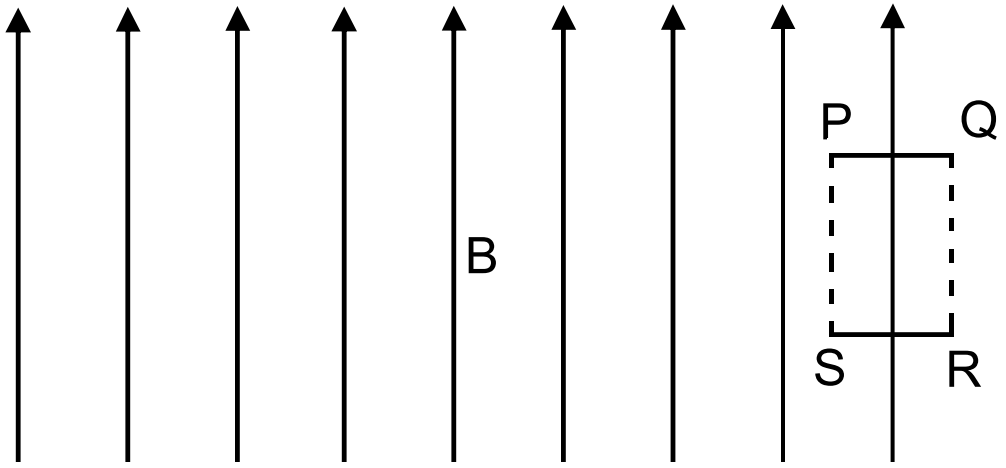
Sometimes we show an idealised magnetic field which is uniform in a given region and falls to zero abruptly. One such field is represented in figure. Using Ampere's law over the path PQRS, show that such a field is not possible.