Question
Do rain drops fall with uniform velocity or with uniform acceleration?

Answer

Rain drops fall with uniform velocity.

Need a full question paper?

Generate a complete, print-ready paper with questions like this in minutes — across 16+ boards, with answer keys.
Start Generating Free

Similar questions

Periodic rise and fall of intensity of sound when two sound waves moving in same direction, having same amplitude but differ in frequency by less than 10 is known as ________.
A body at higher temperature contains more heat. Comment.
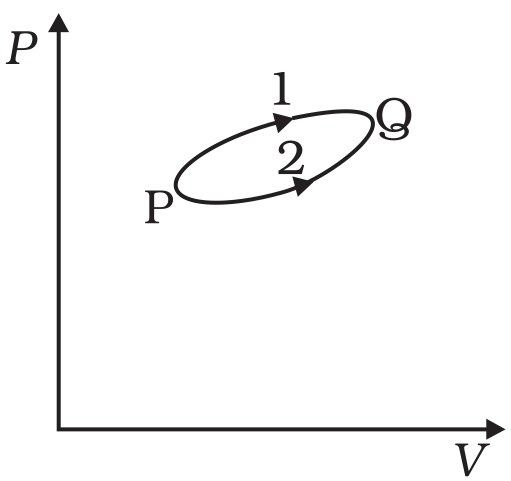
A system goes from P to Q by two different paths in the P-V diagram as shown in Fig. Heat given to the system in path 1 is 1000J. The work done by the system along path 1 is more than path 2 by 100J. What is the heat exchanged by the system in path 2?

An open pipe makes a good musical instrument, in comparison to a closed pipe. Why?
_______ waves do not transfer any energy and momentum in the material medium.
Two charged particles having charge 2.0 × 10-8C each are joined by an insulating string of length 1m and the system is kept on a smooth horizontal table. Find the tension in the string.
In a connected motion of two body, acceleration of both the bodies are _______.
Answer the following questions based on the P-T phase diagram of carbon dioxide
  1. At what temperature and pressure can the solid, liquid and vapour phases of CO2 co-exist in equilibrium ?
  2. What is the effect of decrease of pressure on the fusion and boiling point of CO2?
  3. What are the critical temperature and pressure for CO2? What is their significance?
  4. Is CO2 solid, liquid or gas at (a) –70 °C under 1 atm, (b) –60 °C under 10 atm, 15 °C under 56 atm?
Name at least seven physical quantities whose dimensions are ML2T-2.
Given below are some functions of x and t to represent the displacement (transverse or longitudinal) of an elastic wave. State which of these represent (i) a travelling wave, (ii) a stationary wave or (iii) none at all:
$\text{y}=\cos\text{x}\sin\text{t}+\cos2\text{x}\sin2\text{t}$