Question
Do the points $(3, 2), (–2, –3)$ and $(2, 3)$ form a triangle? If so, name the type of triangle formed.

Answer

Let us apply the distance formula to find the distances PQ, QR and PR, where
P$\leftrightarrow$(3, 2),
Q$\leftrightarrow$(–2, –3) and
R$\leftrightarrow$(2, 3)
are the given points. We have
$\mathrm{PQ}=\sqrt{(3+2)^{2}+(2+3)^{2}}=\sqrt{5^{2}+5^{2}}=\sqrt{50}=7.07(\text { approx. })$
$\mathrm{QR}=\sqrt{(-2-2)^{2}+(-3-3)^{2}}=\sqrt{(-4)^{2}+(-6)^{2}}=\sqrt{52}=7.21(\text { approx. })$
$\mathrm{PR}=\sqrt{(3-2)^{2}+(2-3)^{2}}=\sqrt{1^{2}+(-1)^{2}}=\sqrt{2}=1.41(\text { approx. })$
Since the sum of any two of these distances is greater than the third distance, therefore, the points $P, Q$ and R form a triangle.
Also, $PQ^2 + PR^2 = QR^2 $, by the converse of Pythagoras theorem, we have $\angle P = 90^\circ$ Therefore, PQR is a right triangle.

Need a full question paper?

Generate a complete, print-ready paper with questions like this in minutes — across 16+ boards, with answer keys.
Start Generating Free

Similar questions

Find the lengths of the arcs cut off from a circle of radius 12cm by a chord 12cm long. Also, find the area of the minor gment. $\big[\text{Take }\pi=3.14\text{ and }\sqrt{3}=1.73.\big]$
The $7^{\text {th }}$ term of an AP is -4 and its $13^{\text {th }}$ term is -16 . Find the AP.
The height of a solid cylinder is $15\ cm$ and the diameter of its base is $7\ cm$. Two equal conical holes each of radius $3\ cm$, and height $4\ cm$ are cut off. Find the volume of the remaining solid.
Evaluate the following:
$\cot^230^\circ-2\cos^260^\circ-\frac{3}{4}\sec^245^\circ-4\sec^230^\circ$
How many three digit numbers are divisible by 7?
If one zero of the polynomial $2 x^2+3 x+\lambda$ is $\frac{1}{2}$, find the value of $\lambda$ and other zero.
If a $\triangle\text{ABC},$ AD is the bisector of $\angle\text{A},$ Meeting side BC at D.
If AB = 3.5cm, AC = 4.2cm and DC = 2.8cm, find BD.
In a $\triangle\text{ABC,D}\ \text{and E}$ are points on the sides AB and AC respectively such that DE || BC.
If AD = 6cm, DB = 9cm and AE = 8cm, find AC.
If $\cot\theta=\frac{3}{4},$ prove that $\sqrt{\frac{\sec\theta-\text{cosec }\theta}{\sec\theta+\text{cosec }\theta}}=\frac{1}{\sqrt{7}}.$
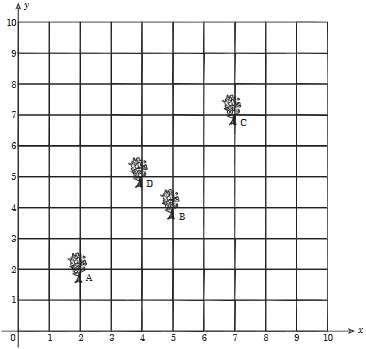
Krishna has an apple orchard which has a $10 m \times$ 10 m sized kitchen garden attached to it. She divides it into a $10 \times 10$ grid and puts soil and manure into it. She grows a lemon plant at A, a coriander plant at B , an onion plant at C and a tomato plant at D. Her husband Ram praised her kitchen garden and points out that on joining A , B, C, D they may form a parallelogram. Look at the below figure carefully and answer the following questions:
Image
(i) Write the coordinates of the points $A , B , C$ and D , using the $10 \times 10$ grid as coordinate axes.
(ii) Find whether ABCD is a parallelogram or not.