Question
Does a conductor become charged when a current is passed through it?

Answer

Yes as charge passes through it is is charged. For example we use electrical magnets in some equipment.

Need a full question paper?

Generate a complete, print-ready paper with questions like this in minutes — across 16+ boards, with answer keys.
Start Generating Free

Similar questions

In the phenomenon of interference, write the value of path difference of superimposed waves at the places where constructive and destructive interference occurs.
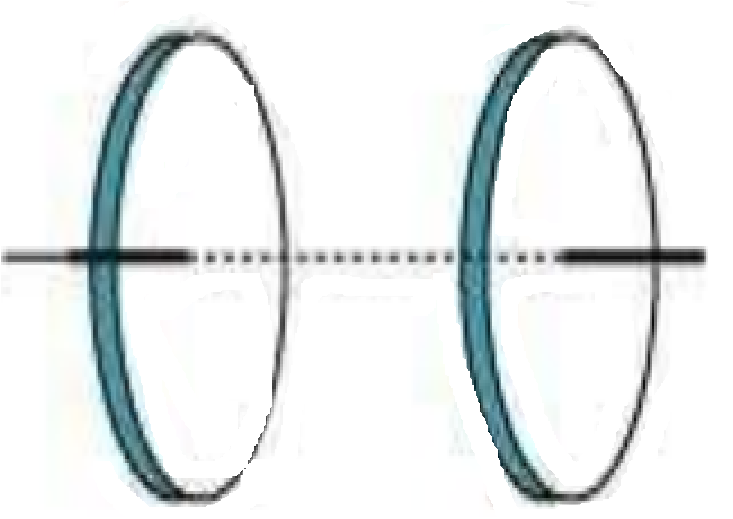
shows a capacitor made of two circular plates each of radius 12 cm, and separated by 5.0 cm. The capacitor is being charged by an external source (not shown in the figure). The charging current is constant and equal to 0.15A.
  1. Calculate the capacitance and the rate of charge of potential difference between the plates.
  2. Obtain the displacement current across the plates.
  3. Is Kirchhoff’s first rule (junction rule) valid at each plate of the capacitor? Explain.
​​​​​​​
Answer the following questions:
Magnetic field lines are always nearly normal to the surface of a ferromagnet at every point. (This fact is analogous to the static electric field lines being normal to the surface of a conductor at every point.) Why?
A long straight current carrying wire passes normally through the centre of circular loop. If the current through the wire increases, will there be an induced emf in the loop? Justify.
Write the ratio of the number of free electrons and holes in an intrinsic semiconductor.
Write the upper and lower limits of interference in terms of path difference.
Can an object be in pure translation as well as in pure rotation?
Four 2cm × 2cm × 2cm cubes of ice are taken out from a refrigerator and are put in 200ml of a drink at 10°C.
  1. Find the temperature of the drink when thermal equilibrium is attained in it.
  2. If the ice cubes do not melt completely, find the amount melted. Assume that no heat is lost to the outside of the drink and that the container has negligible heat capacity. Density of ice = 900kg-m-3, density of the drink = 1000kg-m-3, specific heat capacity of the drink = 4200Jkg-1-K-1, latent heat of fusion of ice = 3.4 × 10⁵J-kg-1.
Consider the situation of the previous problem. If the mirror reflects only 64% of the light energy falling on it, what will be the ratio of the maximum to the minimum intensity in the interference pattern observed on the screen?
What is the focal length of a plane mirror?