Question
Does specific heat of water remain constant throughout?

Answer

No, the specific heat of water changes with temperature range.

Need a full question paper?

Generate a complete, print-ready paper with questions like this in minutes — across 16+ boards, with answer keys.
Start Generating Free

Similar questions

A cylindrical wooden block of cross-section $15.0 \mathrm{~cm}^2$ and mass 230 gm is floated over water with an extra weight 50 gm attached to its bottom. The cylinder floats vertically. From the state of equilibrium, it is slightly depressed and released. If the specific gravity of wood is 0.30 and $\mathrm{g}=9.8 \mathrm{~m}$ per $\mathrm{sec}^2$, find the frequency of oscillation of the block.
The surface tension of water is 72 dyne/cm. Convert it in SI unit.
Write the formula for the terminal velocity of a small bullet freely falling in a viscous fluid.
Answer the following questions based on the P-T phase diagram of carbon dioxide
a. At what temperature and pressure can the solid, liquid and vapour phases of $\mathrm{CO}_2$ co-exist in equilibrium ?
b. What is the effect of decrease of pressure on the fusion and boiling point of $\mathrm{CO}_2$ ?
c. What are the critical temperature and pressure for $\mathrm{CO}_2$ ? What is their significance?
d. Is $\mathrm{CO}_2$ solid, liquid or gas at (a) $-70^{\circ} \mathrm{C}$ under 1 atm , (b) $-60^{\circ} \mathrm{C}$ under $10 \mathrm{~atm}, 15^{\circ} \mathrm{C}$ under 56 atm ?
If $\vec{A}-\vec{B}=\vec{A}+\vec{B}$, then the value of $\vec{B}$ will
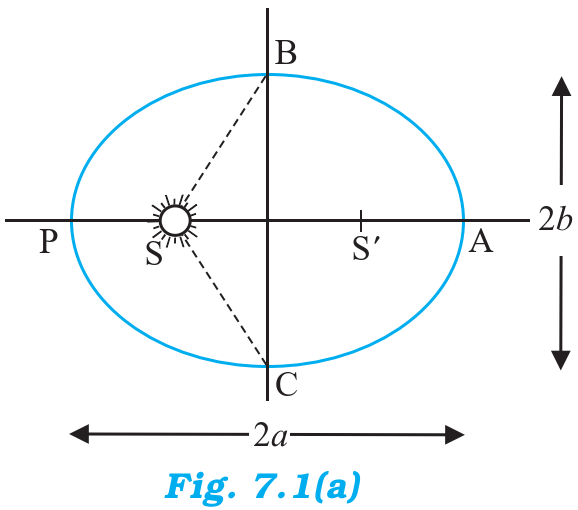
Let the speed of the planet at the perihelion $P$ in Fig. $7.1 (a)$ be $v_p$ and the Sun-planet distance $SP$ be $r_p$ Relate $\left\{r_P, V_P\right\}$ to the corresponding quantities at the aphelion $\left\{r_A, V_A\right\}$. Will the planet take equal times to traverse $\text{B A C}$ and $\text{C P B}$ ?
Image
Put a piece of chalk into water. The chalk will emit bubbles in all directions. Explain.
Two blocks A and B of mass $m_A$ and $m_B$ respectively are kept in contact on a frictionless table. The experimenter pushes the block A from behind so that the blocks accelerate. If the block A exerts a force F on the block B, what is the force exerted by the experimenter on A?
What is the value of modulus of rigidity for a liquid?
Chlorine and carbon dioxide gases are maintained at 27°C. Which gas will have higher average molar kinetic energy of translation and why?