MCQ
$\begin{array}{*{20}{c}}
  {C{l_3}\mathop C\limits^3  - \mathop C\limits^2 H = \mathop C\limits^1 {H_2}} \\ 
  {(I)} 
\end{array}\,\,\,\,\,\,\,\,\,\,\,\,\,\begin{array}{*{20}{c}}
  {{H_3}\mathop C\limits^3  - \mathop C\limits^2 H = \mathop C\limits^1 {H_2}} \\ 
  {(II)} 
\end{array}$

In addition of $HOBr$ to $(I)$ and $(II)$

  • A
    $Br$ is at $C_2$ in both cases
  • B
    $Br$ is at $C_2$ in $II$ and at $C_1$ in $I$
  • $Br$ is at $C_1$ in $II$ and $C_2$ in $I$
  • D
    $Br$ is at $C_1$ in both cases

Answer

Correct option: C.
$Br$ is at $C_1$ in $II$ and $C_2$ in $I$
c

Need a full question paper?

Generate a complete, print-ready paper with questions like this in minutes — across 16+ boards, with answer keys.

Start Generating Free

Similar questions

$H_2 + Cl_2 \longrightarrow 2HCl$ ; $\Delta H = -x\,kJ$
$NaCl + H_2SO_4 \longrightarrow NaHSO_4 + HCl$ ; $\Delta H = -y\,kJ$
$2H_2O + 2Cl_2  \longrightarrow 4HCl + Cl_2$     ;   $\Delta H = -z\,kJ$
From above equation the value of $\Delta H_f$ of $HCl$ is
The volume (in $mL$ ) of $0.1 \ M AgNO _3$ required for complete precipitation of chloride ions present in $30 \ mL$ of $0.01 \ M$ solution of $\left[ Cr \left( H _2 O \right)_5 Cl \right] Cl _2$, as silver chloride is close to
Of the following complexes, the one with the largest value of crystal field splitting energy is
The reactions of $Cl _2$ gas with cold-dilute and hot-concentrated $NaOH$ in water give sodium salts to two (different) oxoacids of chlorine, $P$ and $Q$, respectively. The $Cl _2$ gas reacts with $SO _2$ gas, in presence of charcoal, to give a product $R$. $R$ reacts with white phosphours to give a compound $S$. On hydrolysis, $S$ gives an oxoacid of phosphours $T$

$1.$ $P$ and $Q$, respectively, are the sodium salts of

$(A)$ hypochlorus and chloric acids

$(B)$ hypochlorus and chlorus acids

$(C)$ chloric and perchloric acids

$(D)$ chloric and hypochlorus acids

$2.$ $R , S$ and $T$, respectively, are

$(A)$ $SO _2 Cl _2, PCl _5$ and $H _3 PO _4$

$(B)$ $SO _2 Cl _2, PCl _3$ and $H _3 PO _3$

$(C)$ $SOCl _2, PCl _3$ and $H _3 PO _2$

$(D)$ $SOCl _2, PCl _5$ and $H _3 PO _4$

Give the answer question $1$ and $2.$

$ $
Which of the following is not present in nucleotide ?
Calculate $E_{cell}$ of the reaction ............ $\mathrm{V}$

$Mg\left( s \right) + \mathop {2A{g^ + }}\limits_{(0.0001\,M)}  \to \mathop {M{g^{ + 2}}}\limits_{\left( {0.100\,M} \right)}  + 2Ag\left( s \right)$

If $E_{cell}^o = 3.17\,V$

The solubility of $AgCN$ in a buffer solution of $pH =3$ is $x$. The value of $x$ is

[Assume : No cyano complex is formed; $K _{ sp }( AgCN )$ $=2.2 \times 10^{-16}$ and $\left. K _{ a }( HCN )=6.2 \times 10^{-10}\right]$

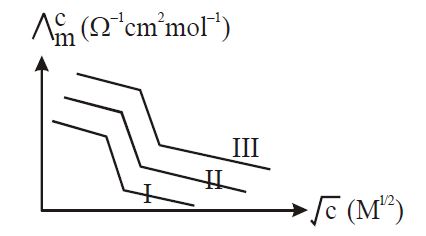
Three graphs for $R(CH_2)_nCOONa$ are as - Correct value of 'n' may be correctly matched as -
The compound most reactive towards $S _{ N } 1$ reaction is :