MCQ
Domain formation is the necessary feature of:
- ✓Ferro magnetism.
- BParamagnetism.
- CDiamagnetism.
- DElectro magnetism.
This problem is based on Magnetism.
Ferro$-$magnetism is the property of certain substances due to which they get strongly attracted to a magnet and strongly influenced in a magnetic field.
Certain substances like iron, nickel, cobalt, etc, are ferro$-$magnetic in nature.
Every atom of such materials, behave like small bar$-$magnets. The proper word is magnetic dipoles. In ferromagnetic materials, there are small regions known as domains. In each domain, all the atoms are alligned in one direction. All of them have their north$-$pole facing one side and their south$-$pole facing the other side. Hence every domain behaves like a dipole.
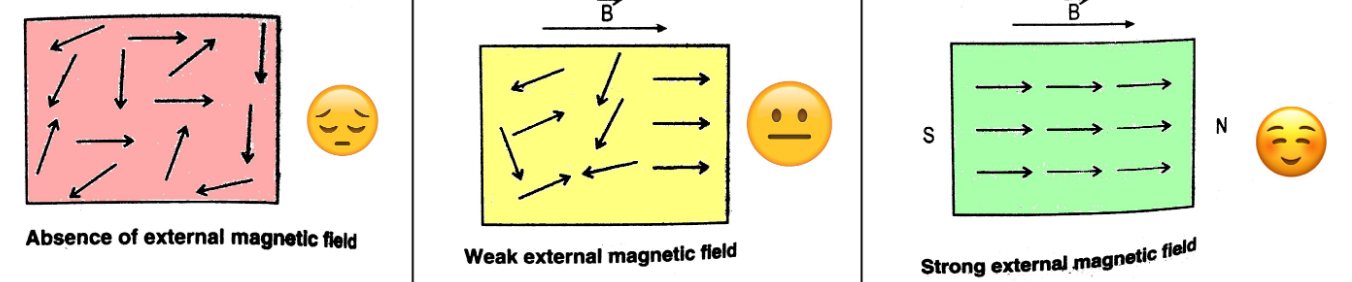
In the above picture, the arrows indicate the domains, pointing towards their north$-$poles.
In the absence of any magnetic field, all the domains are alligned randomly and so, the substance doesn't have any magnetic properties.
When the substance is placed in a weak magnetic field, a few domains turn and allign in the direction of the field, some domains which are already in the direction of the field expand slightly, and those alligned in direction opposite to the field, reduce in size. As a result, the entire substance has a mild dipole$-$like properties.
When the substance is placed in a strong magnetic field, many domains rapidly turn and allign in the direction of the field, the domains which are already in the direction of the field expand tremendously, and those alligned in direction opposite to the field, shrink so much that they almost disappear. As a result, all the domains are parallel to each other and alligned in one direction. The entire substance now becomes a strong bar$-$magnet.
Generate a complete, print-ready paper with questions like this in minutes — across 16+ boards, with answer keys.
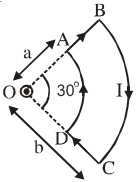
The magnitude of the magnetic field $(B)$ due to the loop $ABCD$ at the origin $(O)$ is :