MCQ
Domain of the function $f(x)\,=\,\frac{1}{{\sqrt {(x + 1)({e^x} - 1)(x - 4)(x + 5)(x - 6)} }}$
  • A
    $( - \infty , - 5) \cup ( - 1,4) \cup (6,8)$
  • B
    $( - \infty , - 5) \cup ( - 1,0) \cup (0,4) \cup (6,\infty )$
  • $( - 5, - 1) \cup (0,4) \cup (6,\infty )$
  • D
    $( - \infty , - 5) \cup ( - 1,4) \cup [6,\infty )$
Answer

Correct option: C.
$( - 5, - 1) \cup (0,4) \cup (6,\infty )$
c
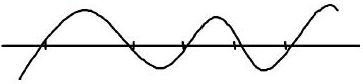
$(x+1)\left(e^{x}-1\right)(x-4)(x+5)(x-6)>0$

$\mathrm{CP}^{\prime}$ $s$ are $\{-1,0,4,-5,6\}$

$\mathrm{x} \in(-5,-1) \cup(0,4) \cup(6, \infty)$

Need a full question paper?

Generate a complete, print-ready paper with questions like this in minutes — across 16+ boards, with answer keys.

Start Generating Free

Similar questions

$\tan^{-1}\frac{1}{11}+\tan^{-1}\frac{2}{11}$ is equal to:
If $\text{f}(\text{x})=\frac{\sin^{-1}\text{x}}{\sqrt{1-\text{x}}^2},$ then $(1-\text{x})^2\text{f}\ ''(\text{x})-\text{xf}(\text{x})=$
Let the solution curve of the differential equation $x \frac{d y}{d x}-y=\sqrt{y^{2}+16 x^{2}}, y(1)=3$ be $y=y(x)$. Then $y (2)$ is equal to
Let $f: \mathbb{R} \rightarrow(0, \infty)$ and $g: \mathbb{R} \rightarrow \mathbb{R}$ be twice differentiable functions such that $f^{\prime \prime}$ and $g^{\prime \prime}$ are continuous functions on $\mathbb{R}$. Suppose $f^{\prime}(2)=g(2)=0, \quad f^{\prime \prime}(2) \neq 0$ and $g^{\prime}(2) \neq 0$. If $\lim _{x \rightarrow 2} \frac{f(x) g(x)}{f^{\prime}(x) g^{\prime}(x)}=1$, then

($A$) $f$ has a local minimum at $x=2$

($B$) fhas a local maximum at $x=2$

($C$) $f^{\prime \prime}(2)>f(2)$

($D$) $f(x)-f^{\prime \prime}(x)=0$ for at least one $x \in \mathbb{R}$

In a $\triangle\text{ABC},$ if C is a right angle, then $\tan^{-1}\Big(\frac{\text{a}}{\text{b}+\text{c}}\Big)+\tan^{-1}\Big(\frac{\text{b}}{\text{c}+\text{b}}\Big)=$
If $f(x) = \frac{x}{{1 + x}}$, then ${f^{ - 1}}(x)$ is equal to
The distance moved by the particle in time $t$ is given by $x=t^3-12 t^2+6 t+8$. At the instant when its acceleration is zero, the velocity is :
The vector equation of the plane containing the line $\vec{\text{r}}=(-2\hat{\text{i}}-3\hat{\text{j}}+\hat{\text{k}})+\lambda(3\hat{\text{i}}-2\hat{\text{j}}-\hat{\text{k}})$ and the point $\hat{\text{i}}+2\hat{\text{j}}+3\hat{\text{k}}$ is:
The number of solutions for the equation $ 2\sin ^{ -1 }{ \sqrt { { \text{x} }^{ 2 }- \text{x}+1 } } +\cos ^{ -1 }{ \sqrt { { \text{x} }^{ 2 }- \text{x} } } =\frac { 3\pi }{ 2 }$ is:
The value of $\int_{-1 / \sqrt{2}}^{1 / \sqrt{2}}\left(\left(\frac{x+1}{x-1}\right)^{2}+\left(\frac{x-1}{x+1}\right)^{2}-2\right)^{1 / 2} d x$ is: