Question
Double fertilisation is immediately followed by development of endosperm. Explain the link between the two processes.

Answer

As the name suggests, double fertilisation involves two types of fertilisation-syngamy and triple fusion. The release of two male gametes into the cytoplasm of one of the synergids causes its degeneration.
One male gamete fuses with the egg cell to form a diploid zygote (which later forms embryo). This process is called syngamy or generative fertilisation. The other male gamete fuses with the two polar nuclei in the central cell by a process called triple fusion, which results in the formation of a triploid.
Primary Endosperm Nucleus (PEN) and the central cell becomes the Primary Endosperm Cell (PEC). This PEC divides repeatedly to form triploid endosperm tissue which further undergoes successive free nuclear divisions to give rise to free nuclear endosperm (free-nuclei).
This stage is followed by the wall formation around the cellular endosperm. Thus, the events of double fertilisation are immediately followed by post-fertilisation events involving development of endosperm.

Need a full question paper?

Generate a complete, print-ready paper with questions like this in minutes — across 16+ boards, with answer keys.
Start Generating Free

Similar questions

State the three principles of Mendel’s law of inheritance.
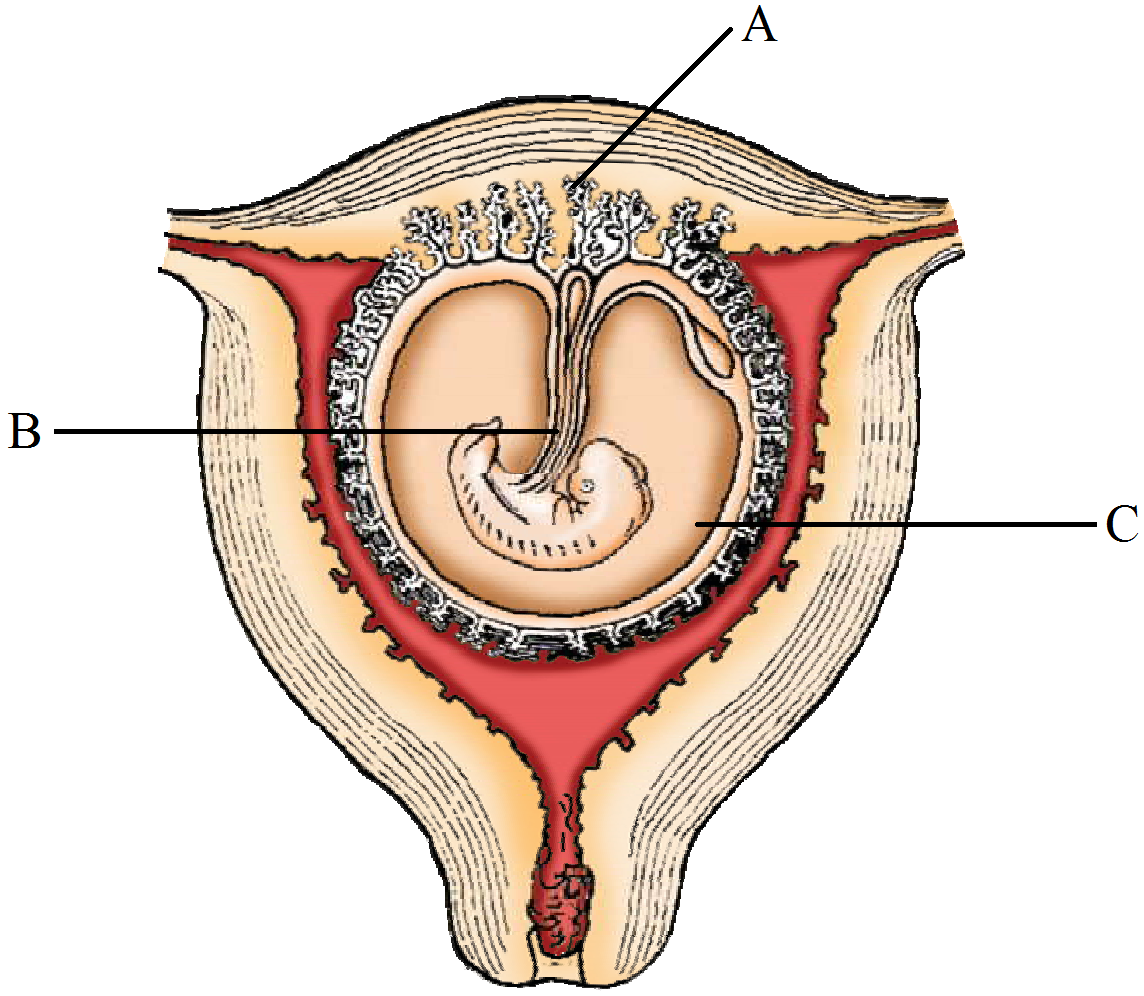
  1. Identify the parts labelled A, B and C in the diagram given.
  1. Draw a labelled diagram of a human blastocyst.
  2. What is parturition and is it induced at the end of pregnancy in a human female?
Answer the following questions:
You are given tall pea plants with yellow seeds whose genotypes are unknown. How would you find the genotype of these plants? Explain with the help of cross.
Describe the functions of the following:
Vas deferens.
  1. State the cause and symptoms of colour-blindness in humans.
  2. Statistical data has shown that 8% of the human males are colour-blind whereas only 0.4% of females are colour-blind. Explain giving reasons how is it so.
List the components of the embryo sac and mention their fate on fertilisation.
OR
Mention the fate of all the components of the embryo sac after fertilisation.
  1. Where are B-cells and T-cells produced in the human body? How do they differ from each other? Mention any two differences.
  2. Name any three classes of immunoglobulins in humans. Write one function of each.
  1. Write an equation for Verhaulst-Pearl Logistic Growth, where.
N - Population density at a timet E.

r - Intrinsic rate of natural increase.

K - Carrying Capacity.
  1. Draw a graph for a population whose population density has reached the carrying capacity.
  2. Why is this logistic growth model considered a more realistic one for most animal populations?
  3. Draw a growth curve where resources are not limiting to growth of a population.
Show that Darwin’s natural selection is based on natural observation, with an example for each.
  1. You are given tall pea plants with yellow seeds, whose genotypes are unknown. How would you find the genotype of these plants? Explain with the help of cross.
  2. Identify A, B and C in the table given below:
Pattern of Inheritance
Monohybrid $F_1$ Phenotypic Expression
Codominance
‘A’
‘B’
Progeny resembled only one of the parents.
Incomplete dominance.
‘C’