Question
Draw a circle with the help of a bangle. Take any point $P$ outside the circle. Construct the pair of tangents from the point $P$ to the circle.
Answer


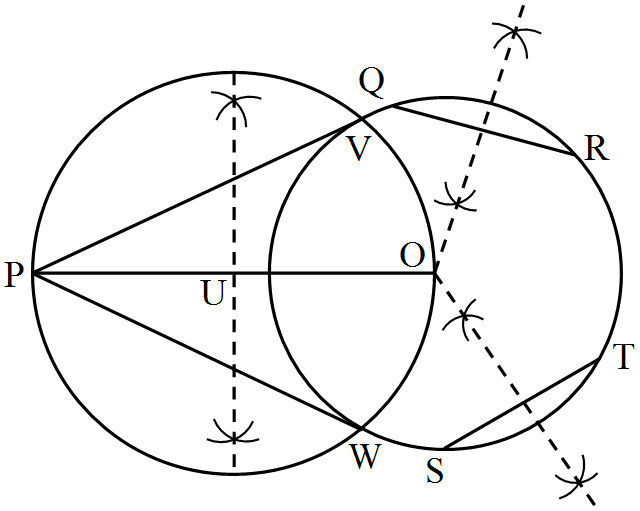
Steps of construction:
1. Drow a circle with the help of bangle.
2. Take a point $P$ outside the circle and take two chords $Q R$ and $S T$.
3. Draw perpendicular bisect of these chords.
4. Join $PO$ and bisect it, Let $U$ be the mid-point of $PO.$
5. Taking $U$ as centere, draw a circle of radius $OU$ , which will intersect the original circle at $V$ and $W .$
6. Join $PV$ and $PW$ are required taZngents.

Need a full question paper?

Generate a complete, print-ready paper with questions like this in minutes — across 16+ boards, with answer keys.

Start Generating Free

Similar questions

Write the steps of construction for drawing a pair of tangents to a circle of radius $3\ cm$, which are inclined to each other at an angle of $60^\circ .$
A two-digit number is such that the product of its digits is $20$. If $9$ is added to the number, the digits interchange their places. Find the number.
The sum of three numbers in $AP$ is $3$ and their product is $-35$. Find the numbers.
Draw a circle of radius $3.5\ cm$. Take two point $A$ and $B$ on one of its extended diameter, each at a distance of $5\ cm$ from its centre. Draw tangents to the circle from each of these points $A$ and $B.$
Show taht the following points are collinear:
$A(8, 1), B(3, -4)$ and $C(2, -5)$
In the centre of a rectangular lawn of dimensions $50\ m \times 40\ m$, a rectangular pond has to be constructed so that the area of the grass surrounding the pond would be $1184m^2$. Find the length and breadth of the pond.
Solve the following systems of equations:
$3\text{x}-\frac{\text{y}+7}{11}+2=10,$
$3\text{y}-\frac{\text{x}+11}{7}=10.$
Solve the following quadratic equation:
$\frac{\text{a}}{(\text{ax}-\text{1})}+\frac{\text{b}}{(\text{bx}-\text{1})}=(\text{a}+\text{b}),$ $\text{x}\neq\frac{1}{\text{a}},\ \frac{1}{\text{b}}$

If $\sin\theta=\frac{12}{13},$ find the value of $\frac{\sin^2\theta-\cos^2\theta}{2\sin\theta\cos\theta}\times\frac{1}{\tan^2\theta}.$

Solve the following quadratic equations by factorization:
$\frac{\text{x}-\text{a}}{\text{x}-\text{b}}+\frac{\text{x}-\text{b}}{\text{x}-\text{a}}=\frac{\text{a}}{\text{b}}+\frac{\text{b}}{\text{a}}$