Question
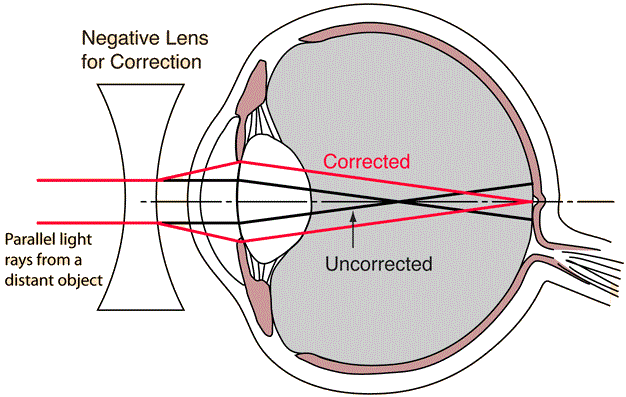
Draw a diagram to show why distant objects cannot be seen distinctly by a myopic eye. List two reasons due to which this defect of vision may be caused. A person with a myopic eye
cannot see objects clearly beyond a distance of 2 m. Name the type of corrective lens that would be needed to correct the defect of vision and draw a ray diagram to show how the defect
gets corrected.
Answer

In order to see objects by the eye the image of the object should form on the retina, exactly on the retina. When a person is suffering from Myopia or near sightedness, the near point
of distinct vision gets Increases and an object placed at a distance less than this new near point has its image formed in front of retina.
If a person can’t see the object clearly beyond 2m then he should use concave or diverging lens in order to correct his defect.

Need a full question paper?

Generate a complete, print-ready paper with questions like this in minutes — across 16+ boards, with answer keys.

Start Generating Free

Similar questions

i. A concave mirror of focal length 10 cm can produce a magnified real as well as virtual image of an object placed in front of it. Draw ray diagrams to justify this statement.
ii. An object is placed perpendicular to the principal axis of a convex mirror of focal length 10 cm . The distance of the object from the pole of the mirror is 10 cm . Find the position of the image formed.
A nuclear reaction is represented by the equation:

$^{2}_{1}\text{H}+{^{2}_{1}\text{H}}\rightarrow{^{3}_{2}\text{He}}+\text{xc}+\text{E}$

  1. Name the process represented by this equation and describe what happens during this reaction.
  2. Identify the particle c and the number x of such particles produced in the reaction.
  3. What does E represent?
  4. State two conditions under which such a reaction takes place.
  5. What type of nuclear bomb is based on similar reactions?
  1. What is an electromagnet? List any two uses.
  2. Draw a labelled diagram to show how an electromagnet is made.
  3. State the purpose of soft iron core used in making an electromagnet.
  4. List two ways of increasing the strength of an electromagnet if the material of the electromagnet is fixed.
How will you conclude that the same potential difference (voltage) exists across three resistors connected in a parallel arrangement to a battery?
Explain the phenomenon of dispersion of white light through a glass prism, using suitable ray diagram.
  1. With the help of a suitable circuit diagram prove that the reciprocal of the equivalent resistance of a group of resistances joined in parallel is equal to the sum of the reciprocals of the individual resistances.
  2. In an electric circuit, two resistors of $12\Omega$ each are joined in parallel to a 6V battery. Find the current drawn from the battery.
  1. Explain with the help of the pattern of magnetic field lines the distribution of magnetic field due to a current carrying a circular loop.
  2. Why is it that the magnetic field of a current carrying coil having n turns, is 'n' times as large as that produced by a single tum (loop)?
Two resistors, with resistances $ 5 Ω$ and $10 Ω$ respectively are to be connected to a battery of emf 6V so as to obtain:
  1. Minimum current flowing.
  2. Maximum current flowing.
  1. How will you connect the resistances in each case?
  2. Calculate the strength of the total current in the circuit in the two cases.
  1. Explain the following terms related to spherical lenses:
  1. Optical centre.
  2. Centres of curvature.
  3. Principal axis.
  4. Aperture.
  5. Principal focus.
  6. Focal length.
  1. A converging lens has focal length of 12 cm. Calculate at what distance should the object be placed from the lens so that it forms an image at 48 cm on the other side of the lens.
List the sign conventions for reflection flight by spherical mirrors. Draw a diagram and apply these conventions in the determination of focal length of spherical mirror which forms a three times magnified real image of an object placed 16 cm infront of it.