Question
Draw a labelled ray diagram to show the image formation in a refracting type astronomical telescope. Why should the diameter of the objective of a telescope be large?

Answer

Alternate Answer
High resolving power/Large light gathering power/Intensity of image more.

Need a full question paper?

Generate a complete, print-ready paper with questions like this in minutes — across 16+ boards, with answer keys.
Start Generating Free

Similar questions

Write down the equation of electric potential for a point $-$ outside the spherical shell $-$ on the surface of a spherical shell and $-$ inside the spherical shell.
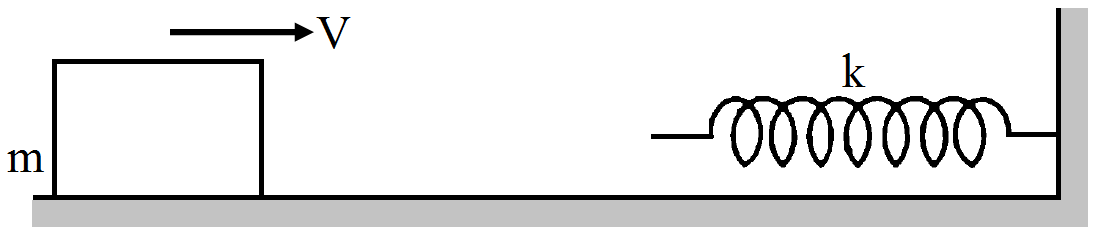
A block of massip, sliding on a smooth horizontal surface with a velocity $\vec{\text{v}}$ meets a long horizontal spring fixed at one end and having spring constant k as shown in figure. Find the maximum compression of tin spring. Will the velocity of the block be the same $\vec{\text{v}}$ when it comes back to the original position shown?
What is the work function of metal? It depends on which factors?
Explain current formed in solid conductors in presence of external electric field.
Distinguish between polarised and unpolarized light. Does the intensity of polarised light emitted by a Polaroid depend on its orientation? Explain briefly.
The vibrations in a beam of polarised light make an angle of 60° with the axis of the polaroid sheet. What percentage of light is transmitted through the sheet?
Draw a labelled ray diagram of an astronomical telescope in the near point position.
Write the expression for its magnifying power.
Can we conclude from the interference phenomenon whether light is a transverse wave or a longitudinal wave?
State the Oersted's observation.
In Ampere's $\oint\overrightarrow{\text{B}}.\text{d}\overrightarrow{\text{l}}=\mu_0\text{i},$ the current outside the curve is not included on the right hand side. Does it mean that the magnetic field B calculated by using Ampere's law, gives the contribution of only the currents crossing the area bounded by the curve?
Consider an ice cube of edge 1.0cm kept in a gravity free hall. Find the surface area of the water when the ice melts. Neglect the difference in densities of ice and water.