Question
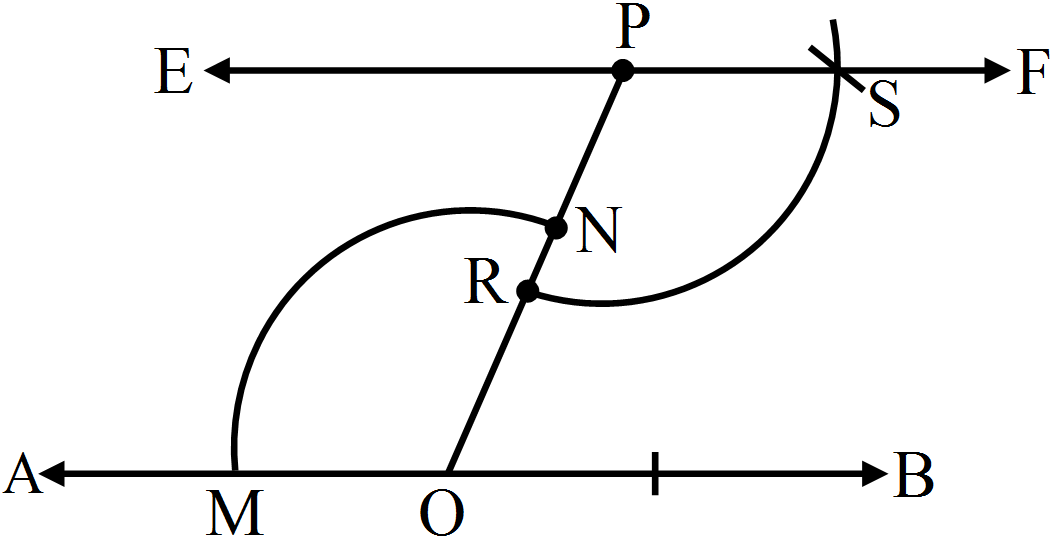
Draw a line $AB$. Take a point $P$ outside it. Draw a line passing through $P$ and parallel to $AB.$
Answer


Steps for construction:
$1.$Draw a line $AB.$
$2.$Take a point $P$ outside $AB$ and another point $O$ on $AB.$
$3.$Draw $PO.$
$4.$Draw $\angle\text{FPO}$ such that $\angle\text{FPO}$ is equal to $AOP.$
$5.$Extend $FP$ to $E.$
Then, the line $EF$ passes through the point $P$ and $EF \| AB.$

Need a full question paper?

Generate a complete, print-ready paper with questions like this in minutes — across 16+ boards, with answer keys.
Start Generating Free

Similar questions

Given $\overline{\text{AB}}$ of length $7.3\ cm$ and $\overline{\text{CD}}$ of length $3.4\ cm,$ construct a line segment $\overline{\text{XY}}$ such that the length of $\overline{\text{XY}}$ is equal to the difference between the lengths of $\overline{\text{AB}}$ and $\overline{\text{CD}}$. Verify by measurement.
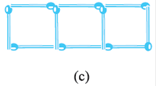
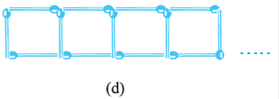
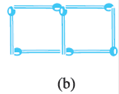
Look at the following matchstick pattern of squares (Fig.). The squares are not separate. Two neighbouring squares have a common matchstick. Observe the patterns and find the rule that gives the number of matchstick in terms of the number of squares. 
(Hint : If you remove the vertical stick at the end, you will get a pattern of Cs.)


A rectangular courtyard is $18m, 72\ cm$ long and $13m, 20\ cm$ board. It is to be paved with square tiles of the same size. Find the least possibele number of such tiles.
Draw a line segment of length $6.5\ cm$ and divide it into four equal parts, using ruler and compasses.
The lengths in km (rounded to nearest hundred) of some major rivers of India is given below:
River Length (in km)
Narmada $1300$
Mahanadi $900$
Brahmputra $2900$
Ganga $2500$
Kaveri $800$
Krishna $1300$
Draw a bar graph to represent the above information.
Draw an angle of $65^\circ$ and draw an angle equal to this angle, using ruler and compasses.
Draw a circle with centre $C$ and radius $3.4\ cm.$ Draw any chord $\overline{\text{AB}}$. Construct the perpendicular bisector of $\overline{\text{AB}}$ and examine if it passes through $C.$
Draw a line $l.$ Take a point $A,$ not lying on $l.$ Draw a line $m$ such that $\text{m}\perp\text{l}$ and passing through $A.$ Using ruler and compasses.
What part of a revolution have you turned through if you stand facing east and turn clockwise to face north?