Question
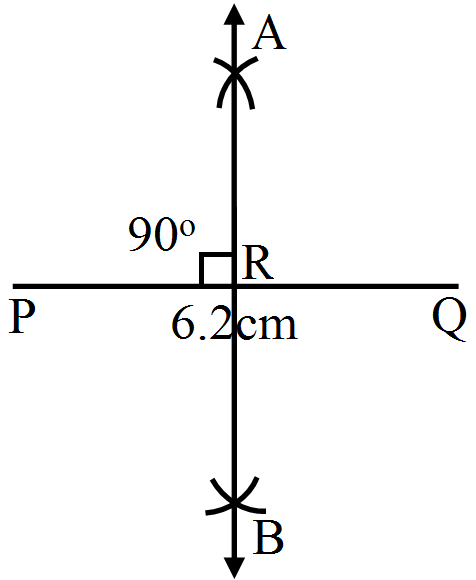
Draw a line segment $PQ = 6.2\ cm$. Draw the perpendicular bisector of $PQ.$
Answer


Steps for construction:
$1.$Draw a line segment $PQ,$ which is equal $6.2\ cm.$
$2.$With $P$ as the centre and radius more than half of $PQ,$ draw arcs, one on each side of $PQ.$
$3.$With $Q$ as the centre and the same radius as before, draw arcs cutting the perviously drawn arcs at $A$ and $B,$ respectively.
$4.$Draw $AB,$ meeting $PQ$ at $R.$

Need a full question paper?

Generate a complete, print-ready paper with questions like this in minutes — across 16+ boards, with answer keys.

Start Generating Free

Similar questions

Write five more fractions of your choice and mark them on the number line.
Match the following:
$1.$
$625 \times 436 = 625 \times 400 + 625 \times 30 + 625 \times 6$
$a$
Commutativity under addition.
$2.$
$25 \times 69 \times 8 = 25 \times 8 \times 69$
$b$
Commutativity under multiplication.
$3.$
$60 + 19758 + 840 = 60 + 940 + 19758$
$c$
Distributivity of multiplication over addition.
Draw an angle of $70^\circ$. Make a copy of it using only a straight edge and compasses.
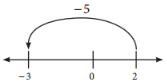
Use unmarked number lines to evaluate these expressions:
Image
(a) -125 + (-30) = _________
(b) +105 – (-55) = _________
(c) +80 – (-150) = _________
(d) -99 – (-200) = _________
In a Mathematics test, the marks were obtained by $40$ students. Arrange these marks in a table using tally marks.
$8$ $1$ $3$ $7$ $6$ $5$ $5$ $4$ $4$ $2$
$4$ $9$ $5$ $3$ $7$ $1$ $6$ $5$ $2$ $7$
$7$ $3$ $8$ $4$ $2$ $8$ $9$ $5$ $8$ $6$
$7$ $4$ $5$ $6$ $9$ $6$ $4$ $4$ $6$ $6$
How many students obtained marks below $4?$
Draw a line segment $PQ$ of length $12\ cm.$ Mark a point $O$ outside this segment. Draw a line through $O$ perpendicular to $PQ.$
Draw a pair of vertically opposite angles. Bisect each of the two angles. Verify that the bisecting rays are in the same line.
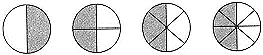
Write the fractions. Are all these fraction equivalent?
Match the following:
$(a)$
Area of a rectangle
$(i)$
$\pi\text{r}^2$
$(b)$
Area of a square
$(ii)$
$4 \times $ side
$(c)$
Perimeter of a rectangle
$(iii)$
$l \times b$
$(d)$
Perimeter of a square
$(iv)$
$(side)^2$
$(e)$
Area of a circle
$(v)$
$2(l + b)$
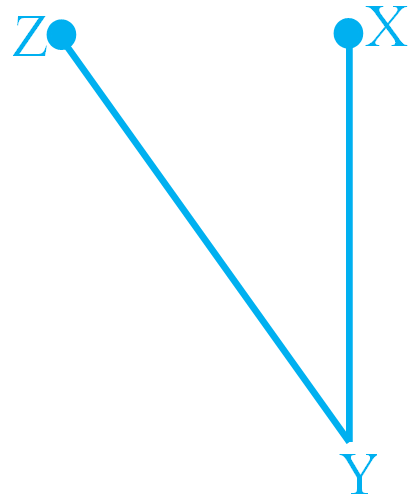
Bisect $\angle\text{XYZ}$ of Figure.