Question
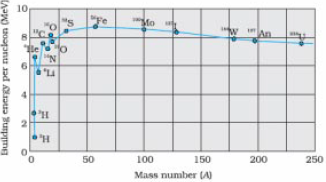
Draw a plot showing the variation of binding energy per nucleon versus the mass number A. Explain with the help of this plot the release of energy in the processes of nuclear fission and fusion.

Answer

Plot:

Explanation: A very heavy nucleus, say A = 240, has lower binding energy per nucleon compared to that of a nucleus with A = 120. Thus if a nucleus A = 240 breaks into two A = 120 nuclei, nucleons get more tightly bound.
This implies energy would be released in the process of fission.
Consider two very light nuclei $({\text{A}}\leq 10) $ joining to form a heavier nucleus. The binding energy per nucleon of the fused heavier nuclei is more than the binding energy per nucleon of the lighter nuclei. This means that the final system is more tightly bound than the initial system. Again energy would be released in such a process of fusion.

Need a full question paper?

Generate a complete, print-ready paper with questions like this in minutes — across 16+ boards, with answer keys.
Start Generating Free

Similar questions

The conductivity of a pure semiconductor is roughly proportional to $\text{T}^\frac{3}{2}\text{e}^{\frac{-\Delta\text{E}}{2\text{kT}}}$ where $\Delta\text{E}$ is the band gap. The band gap for germanium is 0.74eV at 4K and 0.67eV at 300K. By what factor does the conductivity of pure germanium increase as the temperature is raised from 4K to 300K?
Carbon (Z = 6) with mass number 11 decays to boron (Z = 5).
  1. Is it a $\beta^+-\text{decay}$ or a $\beta^--\text{decay}?$
  2. The half-life of the decay scheme is 20.3 minutes. How much time will elapse before a mixture of 90% carbon-11 and 10% boron-11 (by the number of atoms) converts itself into a mixture of 10% carbon-11 and 90% boron-11?
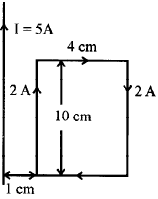
A rectangular loop of wire of size 4cm × 10cm carries a steady current of 2A. A straight long wire carrying 5A current is kept near the loop as shown. If the loop and the wire are coplanar, find
  1. The torque acting on the loop and.
  2. The magnitude and direction of the force on the loop due to the current carrying wire.
A coil of cross $-$ sectional area $A$ lies in a uniform magnetic field $B$ with its plane perpendicular to the field. In this position the normal to the coil makes an angle of $0^\circ$ with the field. The coil rotates at a uniform rate to complete one rotation in time $T$. Find the average induced emf in the coil during the interval when the coil rotates:
$i.$ from $0^{\circ}$ to $90^{\circ}$ position
$ii.$ from $90^{\circ}$ to $180^{\circ}$ position
$iii.$ from $180^{\circ}$ to $270^{\circ}$ and
$iv.$ from $270^{\circ}$ to $360^{\circ}$
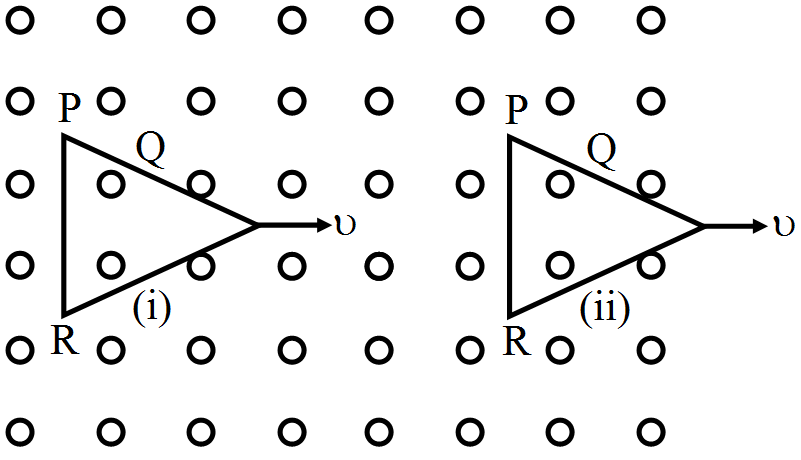
Fig. shows two positions of a loop PQR in a perpendicular uniform magnetic field. In which position of the coil is there an induced emf?
The thickness of a glass plate is measured to be 2.17mm, 2.17mm and 2.18mm at three different places. Find the average thickness of the plate from this data.
A particle moves in a circle of diameter 1.0cm under the action of a magnetic field of 0.40T. An electric field of $200\ Vm^{-1}$ makes the path straight. Find the charge/ mass ratio of the particle.
A wheel of mass 10kg and radius 20cm is rotating at an angular speed of 100rev/min when the motor is turned off. Neglecting the friction at the axle, calculate the force that must be applied tangentially to the wheel to bring it to rest in 10 revolutions.
A small telescope has an objective lens of focal length 144 cm and an eyepiece of focal length 6.0 cm. What is the magnifying power of the telescope? What is the separation between the objective and the eyepiece?
An electron and a positron moving at small speeds collide and annihilate each other. Find the energy of the resulting gamma photon.