Question
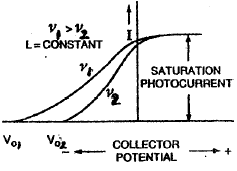
Draw a plot showing the variation of photoelectric current with collector plate potential for two different frequencies, $ν_1 > ν_2,$ of incident radiation having the same intensity. In which case will the stopping potential be higher? Justify your answer.

Answer


Stopping potential is more for the curve corresponding to frequency $v_1$ Stopping potential is directly proportional to the frequency of incident radiation.
Alternate Answer
The maximum energy(of the emitted photoelectrons) increases with an increase in the frequency of the incident radiation.

Need a full question paper?

Generate a complete, print-ready paper with questions like this in minutes — across 16+ boards, with answer keys.

Start Generating Free

Similar questions

Obtain the resonant frequency and Q-factor of a series LCR circuit with L = 3.0H, C = 27μF, and R = 7.4Ω. It is desired to improve the sharpness of the resonance of the circuit by reducing its ‘full width at half maximum’ by a factor of 2. Suggest a suitable way.
The radionuclide $^{11}C$ decays according to
$^{11}_{6}\text{C}\rightarrow^{11}_{5}\text{B}+\text{e}^{+}+\text{v}:\ \text{T}_{1/2}=20.3 \text{ min}$
The maximum energy of the emitted positron is 0.960 MeV.
Given the mass values:
$\text{m}(^{11}_{6})=10=11.011434\text{ u and m}(^{11}_{6}\text{B})=11.009305\text {u}.$
calculate Q and compare it with the maximum energy of the positron emitted.
Derive the formula for the force acting on current carrying rod placed in a magnetic field.
A point charge is moving along a straight line with a constant velocity u. Consider a small area A perpendicular to the direction of motion of the charge (El). Calculate the displacement current through the area when its distance from the charge is x. The value of x is not large so that the electric field at any instant is essentially given by Coulomb's law.
Define electric flux. Write its SI unit.
Using Gauss’s law, deduce an expression for electric field intensity due to an infinitely long straight uniformly charged wire.
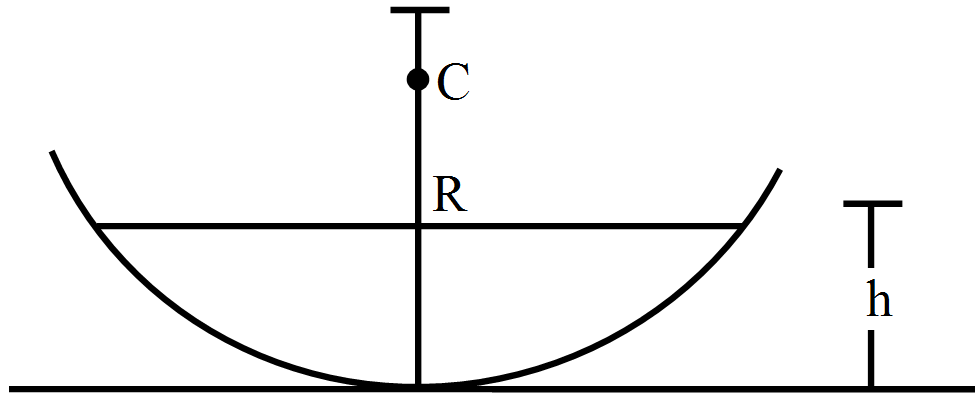
A concave mirror of radius R is kept on a horizontal. Water $\big($refractive index $=\mu\big)$ is poured into it upto a height h. Where should an object be placed so that its image is formed on itself?
A parallel plate capacitor with air between the plates has a capacitance of 8 pF $(1pF = 10^{–12}F)$. What will be the capacitance if the distance between the plates is reduced by half, and the space between them is filled with a substance of dielectric constant 6?
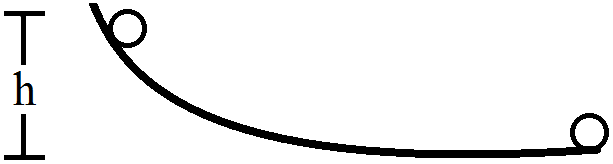
A small spherical ball is released from a point at a height h on a rough track shown in figure. Assuming that it does not slip anywhere, find its linear speed when it rolls on the horizontal part of the track.
What is the energy of a hydrogen atom in the first excited state if the potential energy is taken to be zero in the ground state?
A particle goes in a circle of radius 2.0cm. A concave mirror of focal length 20cm is placed with its principal axis passing through the centre of the circle and perpendicular to its plane. The distance between the pole of the mirror and the centre of the circle is 30cm. Calculate the radius of the circle formed by the image.