Question
Draw a quadrilateral in the Cartesian plane, whose vertices are (-4, 5), (0, 7), (5, -5) and (-4, -2) also find its area.
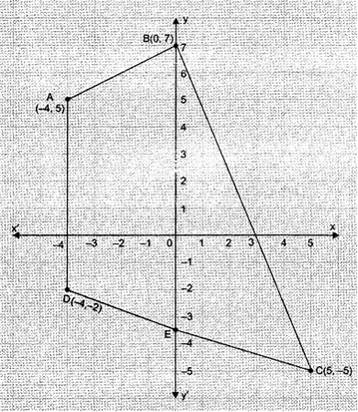
Answer

Area of quadrilateral ABCD = area of $\Delta BCE$ + area of trap. ABED
$ = \frac{1}{2} \times 10.4 \times 5 + \frac{1}{2}(10.4 + 7) \times 4$
$ = 5.2 \times 5 + 2 \times 17.4$
= 26 + 34.8 = 60.8 sq. units.

Need a full question paper?

Generate a complete, print-ready paper with questions like this in minutes — across 16+ boards, with answer keys.

Start Generating Free

Similar questions

An experiment consists of rolling a die until a $2$ appears.
How many elements of the sample space correspond to the event that the $2$ appears not later than the $k^{th}$ roll of the die?
$[$Hint: $1 + 5 + 52 + ... + 5^{k-1}]$
If the different permutations of all the letter of the word EXAMINATION are listed as in a dictionary, how many words are there in this list before the first word starting with E?
Let A = {x, y, z} and B = {a, b}. Find the total number of relations from A into B.
In a certain city, all telephone numbers have six digits, the first two digits always being $41$ or $42$ or $46$ or $62$ or $64$. How many telephone numbers have all six digits distinct?
Evaluate the following limit:
$\lim\limits_{\text{x}\rightarrow0}(\text{cosec x}-\cot\text{x})$
How many words, with or without meaning, each of $3$ vowels and $2$ consonants can be formed from the letters of the word INVOLUTE$?$
In a group of 70 people, 37 like coffee, 52 like tea and each person likes at least one of the two drinks. How many like both coffee and tea?
Prove that: $\frac{\tan^22\text{x}-\tan^2\text{x}}{1-\tan^22\text{x}\tan^2\text{x}}=\tan3\text{x}\tan\text{x}$
To receive Grade 'A', in a course, one must obtain an average of 90 marks or more in five examinations (each of 100 marks). If Sunita's marks in first four examinations are 87, 92, 94. and 95, find minimum marks that Sunita must obtain in fifth examination to get Grade 'A' in the course.
If $(1+\text{i})\text{z}=(1-\text{i})\bar{\text{z}},$ then show that $\text{z}=-\text{i}\bar{\text{z}}.$