Question
  1. Draw a ray diagram showing the image formation by a compound microscope. Hence obtain expression for total magnification when the image is formed at infinity.
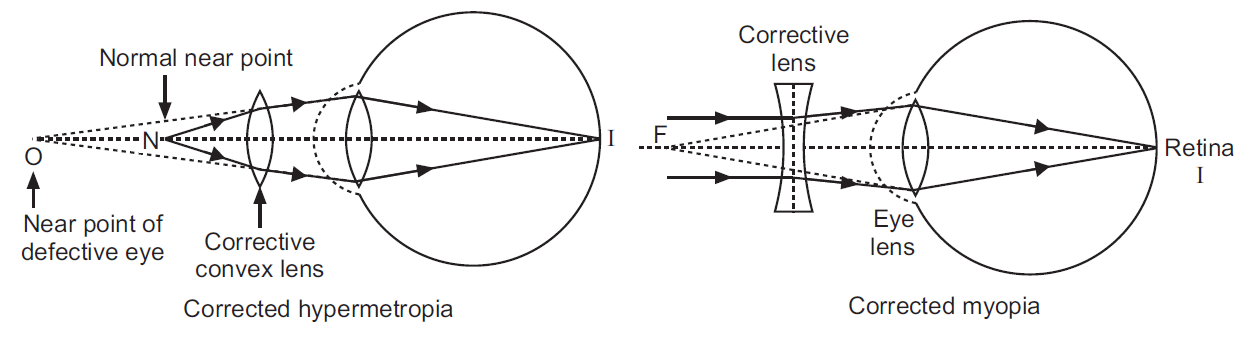
  2. Distinguish between myopia and hypermetropia. Show diagrammatically how these defects can be corrected.
Answer

  1. Difference between myopia and hypermetropia
Myopia Hypermetropia
  1. The eye ball is elongated.
  1. The eye ball is shortened.
  1. Person cannot see distant objects clearly.
  1. Person cannot see near objects clearly.
  • Myopic eye is corrected by interposing a concave lens between eye and object.
  • Hypermetropia is corrected by interposing a convex lens between eye and object.
  1. If image A 'B' is exactly at the focus of the eyepiece, then image A "B" is formed at infinity. If the object AB is very close to the focus of the objective lens of focal length $f_o$, then magnification $M_o$ by the objective lens
$\text{M}_{e} = \frac{\text{L}}{\text{f}_{o}}$
where L is tube length (or distance between lenses $L_o$ and $L_e$)
Magnification $M_e$ by the eyepiece
$\text{M}_{e} = \frac{\text{D}}{\text{f}_{e}}$
where D = Least distance of distinct vision Total magnification $m = M_oM_e$​​​​​​​
$ = \bigg(\frac{\text{L}}{\text{f}_{o}}\bigg)\bigg(\frac{\text{D}}{\text{f}_{e}}\bigg).$

Need a full question paper?

Generate a complete, print-ready paper with questions like this in minutes — across 16+ boards, with answer keys.

Start Generating Free

Similar questions

Using Huygens’ Principle, draw a diagram to show propagation of a wavefront originating from a monochromatic point source. Explain briefly.
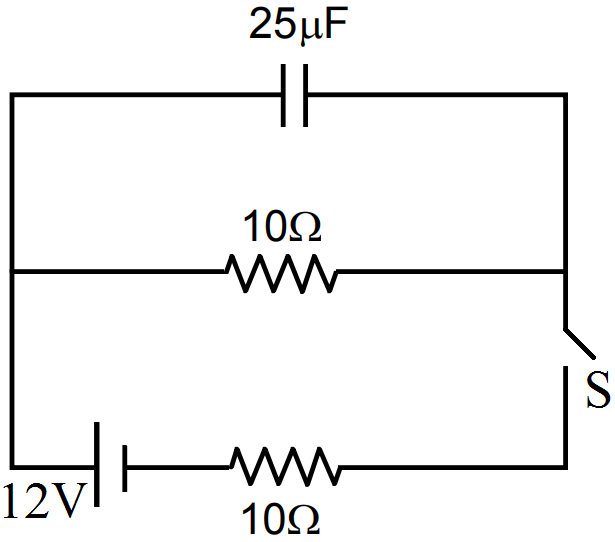
The switch S shown in figure. is kept closed for a long time and is then opened at t = 0. Find the current in the middle $1.0\Omega$ resistor at t = 1ms.
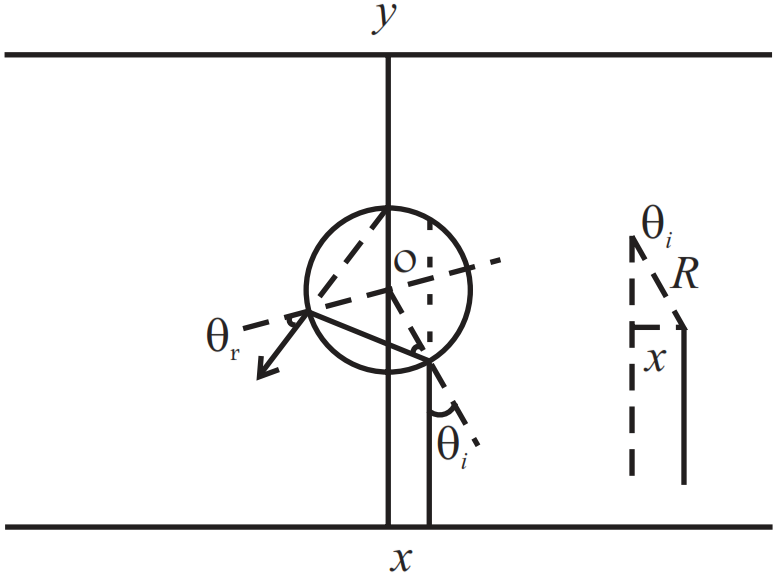
An infinitely long cylinder of radius R is made of an unusual exotic material with refractive index -1 (Fig). The cylinder is placed between two planes whose normals are along the y direction. The center of the cylinder O lies along the y-axis. A narrow laser beam is directed along the y direction from the lower plate. The laser source is at a horizontal distance x from the diameter in the y direction. Find the range of x such that light emitted from the lower plane does not reach the upper plane.
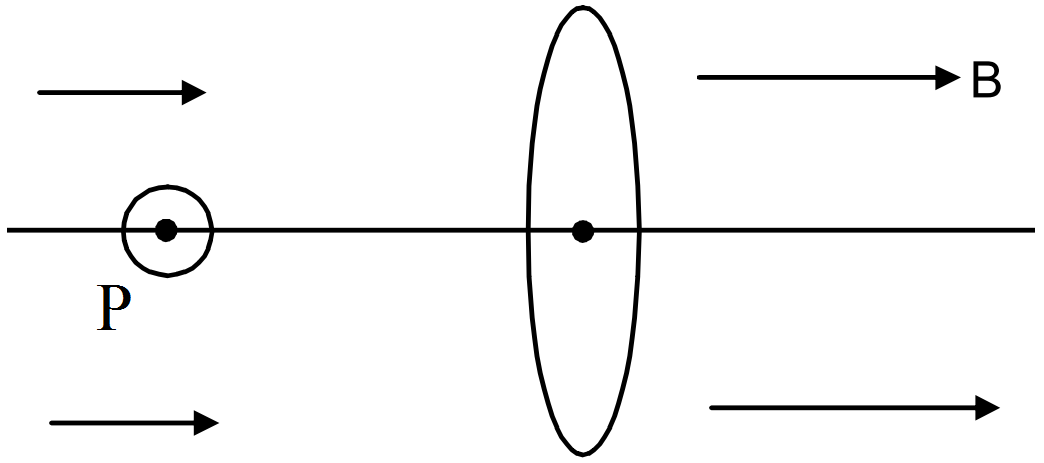
Shows a convex lens of focal length 12cm lying in a uniform magnetic field B of magnitude 1.2T parallel to its principal axis. A particle with charge $2.0 \times 10^{-3}C$ and mass $2.0 \times 10^{-5}$ kg is projected perpendicular to the plane of the diagram with a speed of $4.8 ms^{-1}$. The particle moves along a circle with its centre on the principal axis at a distance of 18cm from the lens. Show that the image of the particle moves along a circle and find the radius of that circle.
What is the difference between cathode rays and beta rays? When the two are travelling in space, can you make out which is the cathode ray and which is the beta ray?
The plates of a capacitor are 2.00cm apart. An electronproton pair is released somewhere in the gap between the plates and it is found that the proton reaches the negative plate at the same time as the electron reaches the positive plate. At what distance from the negative plate was the pair released?
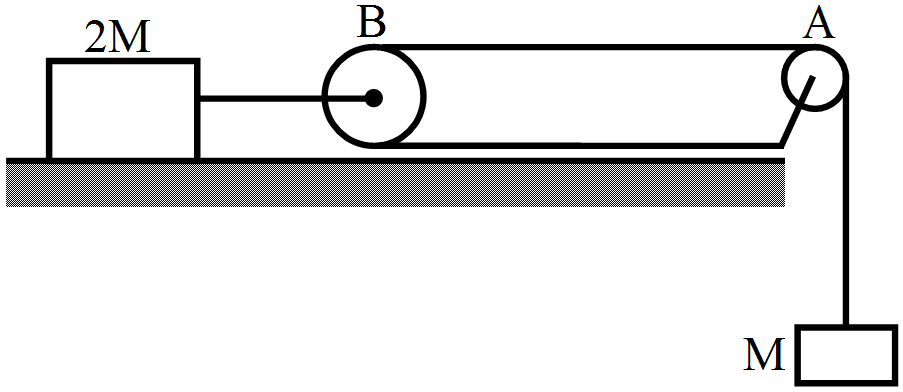
Consider the situation shown in figure. Both the pulleys and the string are light and all the surfaces are frictionless.
  1. Find the acceleration of the mass M.
  2. Find the tension in the string.
  3. Calculate the force exerted by the clamp on the pulley A in the figure.
Explain Hertz experiment for communication of electromagnetic waves. Draw labelled diagram of apparatus used in the experiment.
$(or)$
Explain Hertz experiment related with electromagnetic waves and also explain experiments of Jagdish Chandra Basu and Marconi.
$(or)$
Critically evaluate Hertz experiment of production and communication of electromagnetic waves.
A particle of charge $2.0 \times 10^{-8}C$ and mass $2.0 \times 10^{-10}g$ is projected with a speed of $2.0 \times 10^3m/s^{-1}$ in a region with a uniform magnetic field of 0.10T. The velocity is perpendicular to the field. Find the radius of the circle formed by the particle and also the time period.
Will the focal length of a lens for red light be more, same or less than that for blue light?