Question
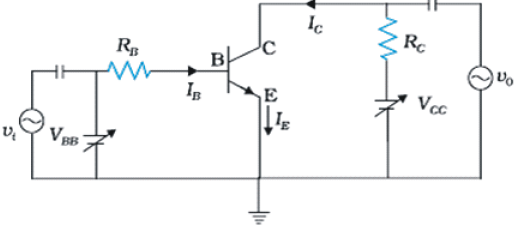
Draw a simple circuit of a CE transistor amplifier. Explain its working. Show that the voltage gain, $A_V$, of the amplifier is given by $\text{A}_{V} = - \frac{\beta_{ac}\text{R}_{L}}{\text{r}_{i}},\text{ where} \beta_{ac}$is the current gain, $R_L$ is the load resistance and $r_i $ is the input resistance of the transistor. What is the significance of the negative sign in the expression for the voltage gain?
Answer


When an ac input signal $v_i$ is superimposed on the bias $v_{BB}$, the output, which is measured between collector and ground, increases.
$\text{v}_{CC} = \text{v}_{CE} + \text{I}_{C}\text{R}_{L}$
$\text{v}_{BB} =\text{v}_{RE} + \text{I}_{B} \text{R}_{B}$
When $\text{v}_{i}$ is not zero, we have
$\text{v}_{BE} + \text{v}_{i} = \text{v}_{BE} + \text{I}_{B} \text{ R}_{B} +\Delta\text{I}_{B}(\text{R}_{B} + \text{R}_{i})$
$ = > \text{v}_{i} = \Delta\text{I}_{B}(\text{R}_{B} + \text{R}_{i})$
$\text{v}_{i} =\text{r}\Delta\text{I}_{B}$
Change in $\text{I}_{B}$ causes a change in $\text{I}_{C}$
Hence, $\beta_{ac} = \frac{\Delta\text{I}_{C}}{\Delta\text{I}_{B}} =\frac{\text{I}_{C}}{\text{I}_{B}}$
As $\Delta\text{V}_{CC} = \Delta\text{V}_{CE} + \text{R}_{L}\Delta\text{I}_{C} = 0 $
$ => \Delta\text{V}_{CE} = - \text{R}_{L}\Delta\text{I}_{C}$
$ = > \text{V}_{o} = -\text{R}_{L}\Delta\text{I}_{C}$
$\beta_{ac}\Delta\text{I}_{B}\text{R}_{L}$
$= > $ voltage gain of the amplifier
$\text{A}_{V} =\frac{\text{V}_{o}}{\text{V}_{i}} =\frac{\Delta\text{V}_{CE}}{\text{r}\Delta\text{I}_{B}} = \frac{-\beta_{ac}\Delta\text{I}_{B}\text{R}_{L}}{\text{r}\Delta\text{I}_{B}}$
Negative sign in the expression shows that output voltage and input voltage have phase difference of $\pi$.
Alternate Answer
(Also accept this derivation for voltage gain expression)
$\text{A}_{V}=\frac{\Delta\text{V}_{CE}}{\Delta\text{V}_{BE}} = \frac{-\Delta\text{I}_{C}\text{R}_{L}}{\Delta\text{I}_{B}\text{R}_{L}} $
But current gain
$\beta_{ac} = \frac{-\Delta\text{I}_{C}}{\Delta\text{I}_{B}}$
$ =\text{A}_{v} = - \beta_{ac}\times\frac{\text{R}_{L}}{\text{R}_{L}}\bigg].$

Need a full question paper?

Generate a complete, print-ready paper with questions like this in minutes — across 16+ boards, with answer keys.

Start Generating Free

Similar questions

The separation between the objective and the eyepiece of a compound microscope can be adjusted between 9.8cm to 11.8cm. If the focal lengths of the objective and the eyepiece are 1.0cm and 6cm respectively, find the range of the magnifying power if the image is always needed at 24cm from the eye.
A car moving at 108km/h finds another car in front of it going in the same direction at 72km/h. The first car sounds a horn that has a dominant frequency of 800Hz. What will be the apparent frequency heard by the driver in the front car? Speed of sound in air = 330m/s.
In a semiconductor, electrons and holes move in opposite directions to each other. How? Explain with figure.
Write characteristics of different components of electromagnetic waves and describe them.
In Young’s double-slit experiment using monochromatic light of wavelength λ, the intensity of light at a point on the screen where path difference is λ, is K units. What is the intensity of light at a point where path difference is λ/3?
A man of mass M having a bag of mass m slips from the roof of a tall building of height H and starts falling vertically. When at a height h from the ground, he notices that the ground below him is pretty hard, but there is a pond at a horizontal distance x from the line of fall. In order to save himself he throws the bag horizontally (with respect to himself) in the direction opposite to the pond. Calculate the minimum horizontal velocity imparted to the bag so that the man lands in the water. If the man just succeeds to avoid the hard ground, where will the bag land?
Can reflection result in plane polarised light if the light is incident on the interface from the side with higher refractive index?
A circuit containing a $80 mH$ inductor and a $60 \mu F$ capacitor in series is connected to a $230 V, 50 Hz$ supply. The resistance of the circuit is negligible.
$a$. Obtain the current amplitude and rms values.
$b.$ Obtain the rms values of potential drops across each element.
$c$. What is the average power transferred to the inductor?
$d. $ What is the average power transferred to the capacitor?
$e$. What is the total average power absorbed by the circuit? $[$‘Average’ implies ‘averaged over one cycle’.$]$
A capacitor having a capacitance of $100\mu\text{F}$ is charged to a potential difference of 24V. The charging battery is disconnected and the capacitor is connected to another battery of emf 12V with the positive plate of the capacitor joined with the positive terminal of the battery:
  1. Find the charges on the capacitor before and after the reconnection.
  2. Find the charge flown through the 12V battery.
  3. Is work done by the battery or is it done on the battery? Find its magnitude.
  4. Find the decrease in electrostatic field energy.
  5. Find the heat developed during the flow of charge after reconnection.
A piece of iron of mass 100 g is kept inside a furnace for a long time and then put in a calorimeter of water equivalent 10 g containing 240 g of water at $20^{\circ} \mathrm{C}$. The mixture attains and equilibrium temperature of $60^{\circ} \mathrm{C}$. Find the temperature of the furnace. Specific heat capacity of iron $=470 \mathrm{J\ kg}^{-10} \mathrm{C}^{-1}$.