Question
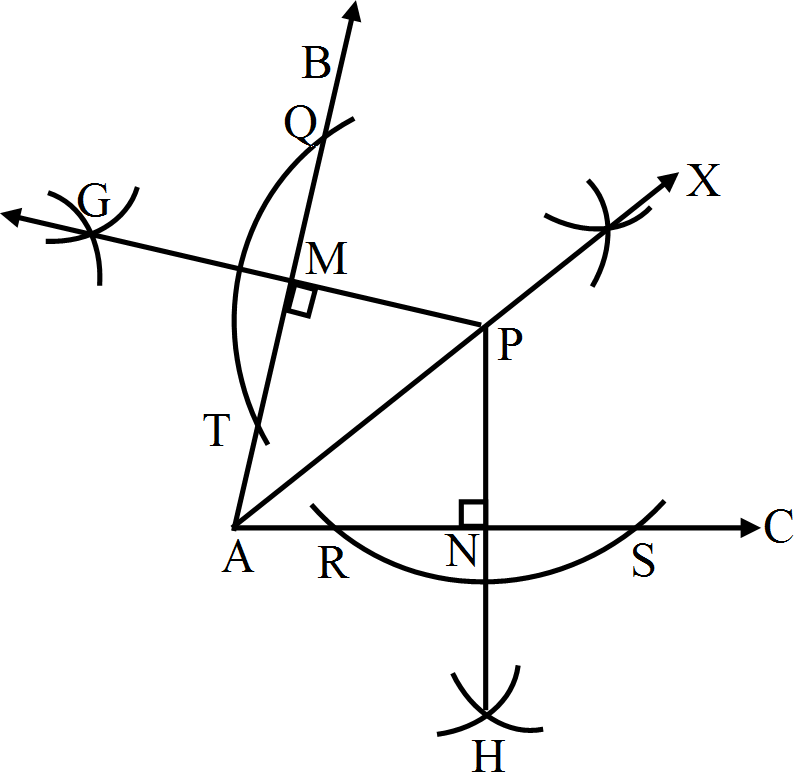
Draw an angle and label it as $\angle\text{BAC}.$ Draw its bisector ray AX and take a point P on it. From P draw line segments PM and PN, such that $\text{PM}\perp\text{AB}$ and $\text{PN}\perp\text{AC},$ where M and N are respectively points on rays AB and AC. Measure PM and PN. Are the two lengths equal?
Answer

  1. Draw $\angle\text{BAC}$ on the line segment AC.
With a convenient radius and A as centre, draw an arc from AB and AC.
  1. The points where arc cuts AB and AC, take both points as centres and draw two small arcs intersecting at X. Now, draw AX.
  2. Take a point P on the ray AX.
  3. Take a convenient radius with P as centre and construct an arc intersecting the line segments AB at T and Q and AC at R and S, respectively.
  4. Using the same radius and with T and Q as centres, construct two arcs intersecting at G on the other side.
  5. Using the same radius and with R and S as centres, construct two arcs intersecting at H on the other side.
  6. Join PG and PH, which intersects AB and AC at M and N, respectively.
On measuring PM and PN using a ruler, we find that both are equal.

Need a full question paper?

Generate a complete, print-ready paper with questions like this in minutes — across 16+ boards, with answer keys.

Start Generating Free

Similar questions

Margarette works in a factory and earns Rs. 955 per month. She saves Rs. 185 per month from her earnings. Find the ratio of:
  1. Her savings to her income.
  2. Her income to her expenditure.
  3. Her savings to her expenditure.
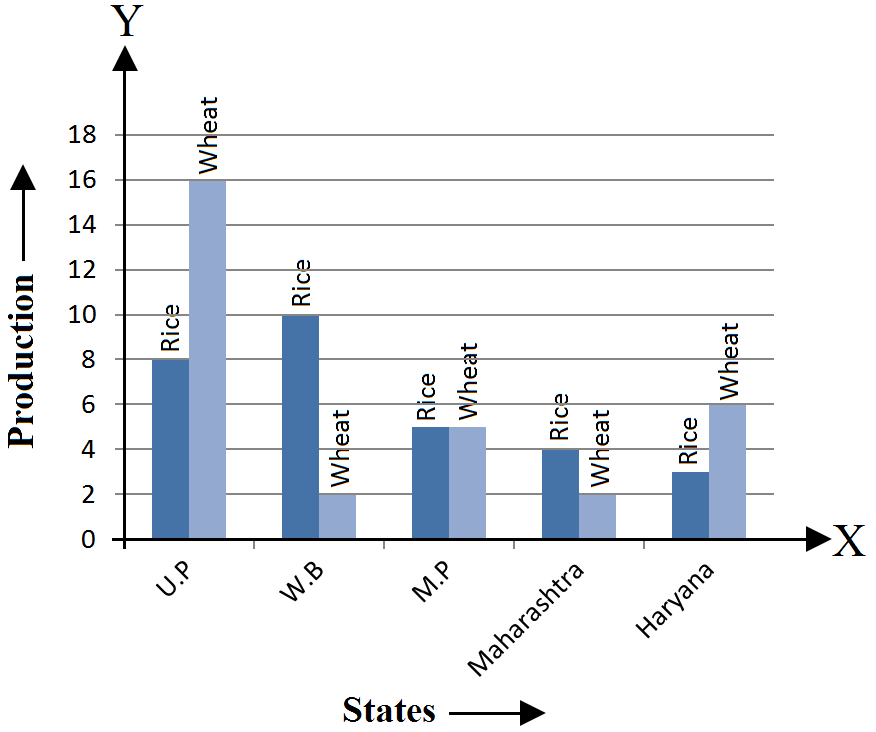
Read the following bar group and answer the following questions:
  1. What information is given by the bar group?
  2. Which state is the largest producer of rice?
  3. What state is the largest producer of wheat?
  4. Which state has total production of rice and wheat as its maximum?
  5. Which state has the total production of wheat and eice minimum?
Using a pair of compasses construct the following angles:
90°
Draw a line AB and take two points C and E on opposite sides of AB. Through C, draw $\text{CD}\perp\text{AB}$ and through E draw $\text{EF}\perp\text{AB}.$ ruler and set-squares.
Round off each of the following numbers to nearest tens, hundreds and thousands:
  1. 964
  2. 1049
  3. 45,634
  4. 79,085
Using protractor, draw a right angle. Bisect it to get an angle of measure 45°.
Use a pair of compasses and construct the following angles:
$67\frac{1}{2}^\circ$
Draw a line l. Take a point A, not lying on l. Draw a line m such that $\text{m}\perp\text{l}$ and passing through A. Using ruler and compasses.
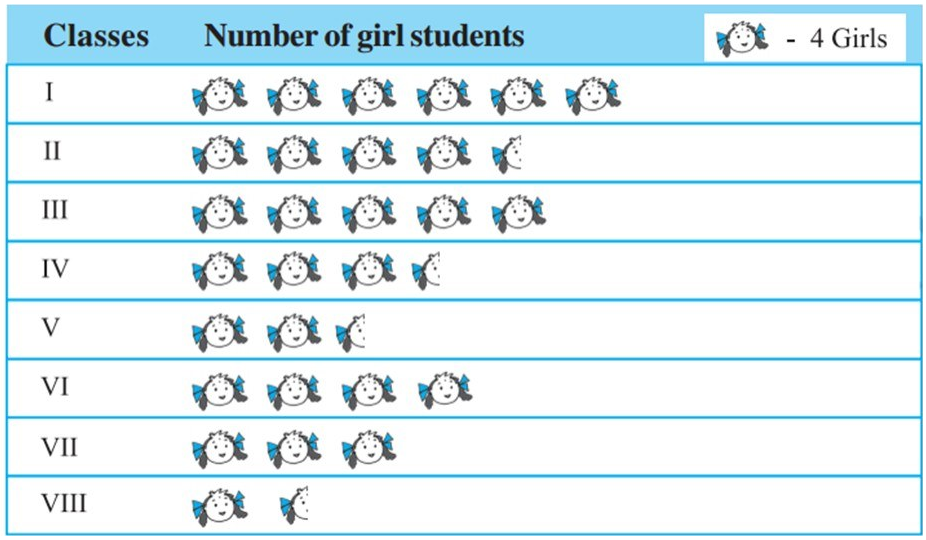
The number of girl students in each class of co-ed. Middle school is depicted by the following pictograph:

Observe the above pictograph and answer the following questions:
  1. Which class has the maximum number of girl students?
  2. Is the number of girls in class VI is less than the number of girls in class V?
  3. How many girls are there in VII class?
Using a protractor, draw $\angle\text{BAC}$ of measure 70°. On side AC, take a point P, such that AP = 2cm. From P draw a line perpendicular to AB.