Question
Draw less than and more than ogive (cumulative frequency curve) using the given data:
Marks Scored
10-20
20-30
30-40
40-50
No. of Students
5
10
30
5

Answer

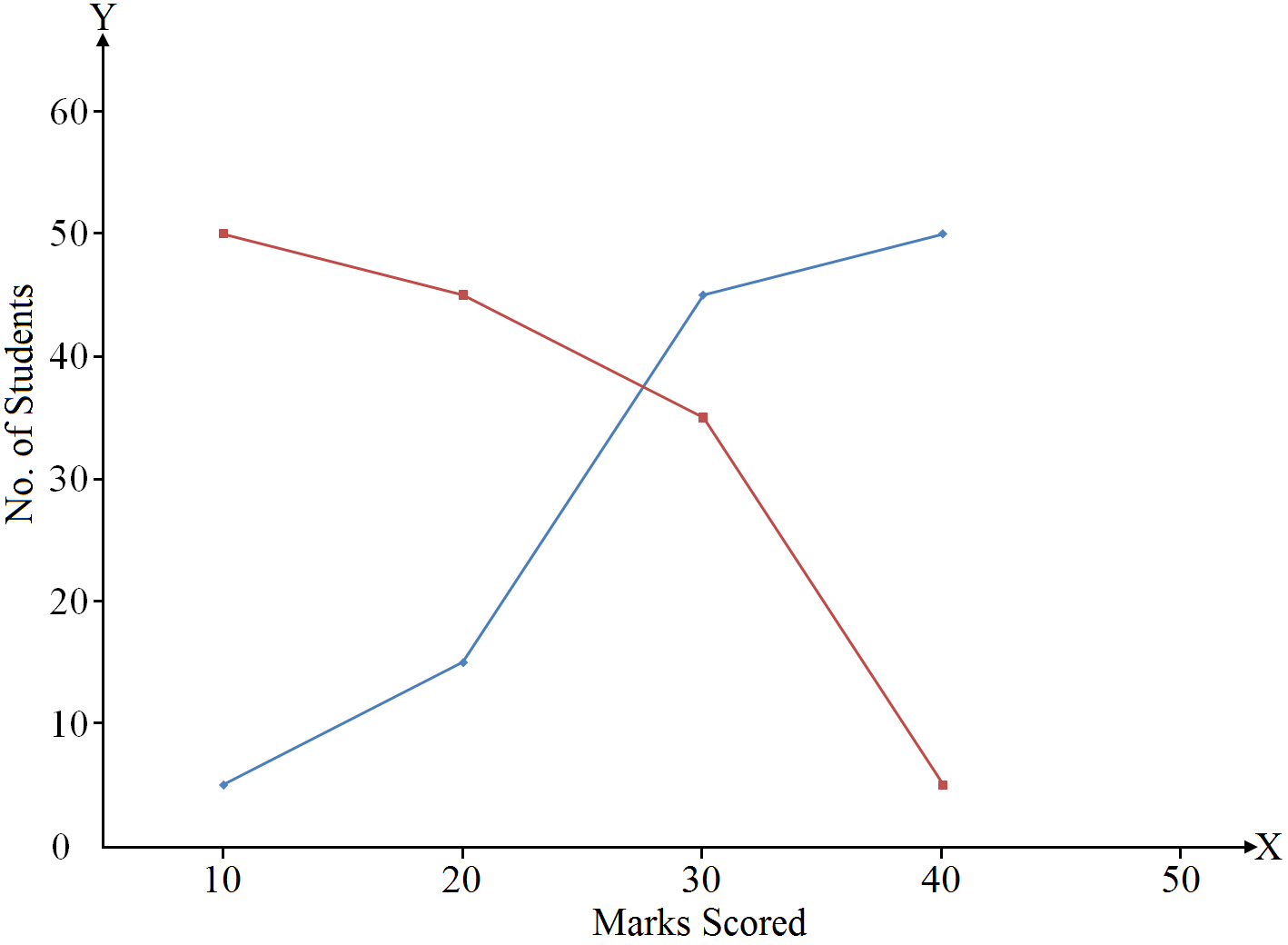
Firstly, we will convert the given data into less than and more than frequency distribution.
Marks Scored
Number of Students
c.f. (less than)
c.f. (more than)
10-20
5
5
50
20-30
10
15
45
30-40
30
45
35
40-50
5
50
5

Need a full question paper?

Generate a complete, print-ready paper with questions like this in minutes — across 16+ boards, with answer keys.

Start Generating Free

Similar questions

Calculate First Quartile and Third Quartile from the following.
Marks
5-15
15-25
25-35
35-45
45-55
No. of Students
8
12
15
9
6
Calculate Laspeyre’s and Paasche's price index numbers on the basis of the following data:
Commodity
A
B
C
D
E
Base Year Price ($p_0)$
10
25
30
15
20
Current Year Price ($p_1)$
15
40
45
30
25
Base Year Quantity $(q_0)$
6
10
15
20
8
Current Year Quantity $(q_1)$
8
20
12
15
6
Calculate Karl Pearson's coefficient of correlation from following data:
X
21
22
23
24
25
26
27
Y
16
15
17
18
19
20
21
Given the following data:
Year CPI of industrial workers (1982 = 100) CPI of agricultural labourers (1986–87 = 100) WP (1993–94=100)
1995-96 313 234 121.6
1996-97 342 256 127.2
1997-98 366 264 132.8
1998-99 414 293 140.7
1999-00 428 306 145.3
2000–01 444 306 155.7
2001–02 463 309 161.3
2002–03 482 319 166.8
2003–04 500 331 175.9
Source: Economic Survey, 2004–2005, Government of India:
  1. Comment on the relative values of the index numbers.
  2. Are they comparable?
Define wholesale price index numbers. Give its uses.
From the following data, calculate coefficient of quartile deviation.
Wages less than: 10 20 30 40 50 60 70
No. of Workers: 5 8 15 20 30 33 35
What do you understand by price elasticity of demand? How is it measured? Explain.
An enquiry into the budgets of the middle class families in a certain city gave the following information:
Expenses on items Food 35% Fuel 10% Clothing 20% Rent 15% Misc. 20%
Price (in ₹) in 2004 1500 250 750 300 400
Price (in ₹) in 1995 1400 200 500 200 250
What is the cost of living index during the year 2004 as compared with 1995?
Calculate the coefficient of variation of the given continuous series.
More than: 0 10 20 30 40 50 60 70
Cumulative Frequency: 100 90 75 50 20 10 5 0
Hint: Since, 'more than' distribution is givan, we first convert it into exclusive distribution.
Draw a Lorenz curve from the data given below:
Income: 100 200 400 500 800
No. of Persons: 80 70 50 30 20