Question

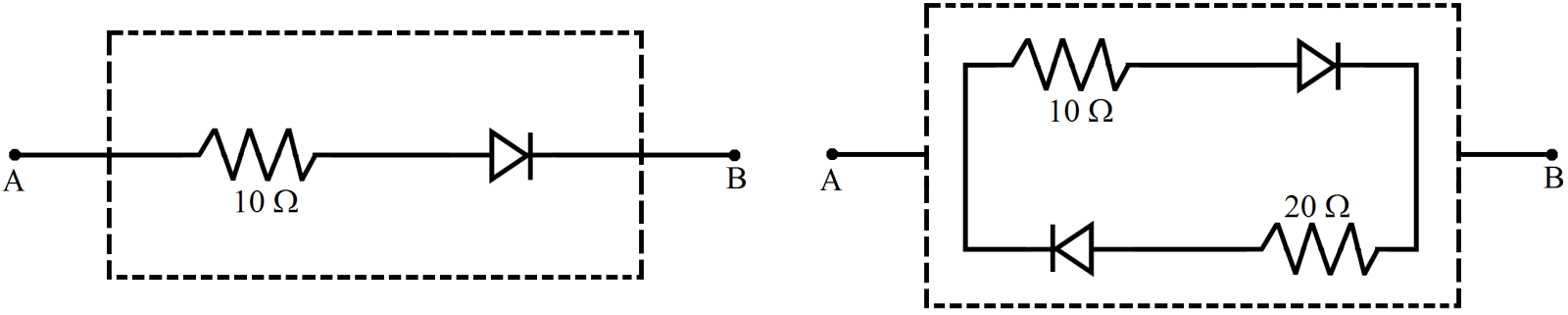
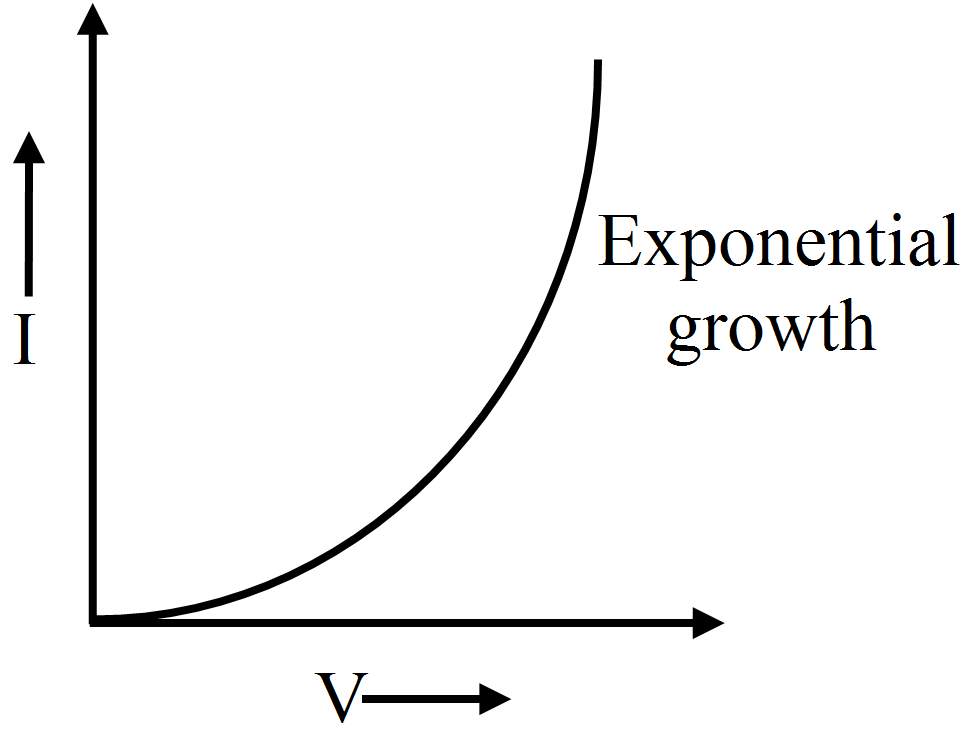
Draw the current-voltage characteristics for the device shown in figure. between the terminals A and B.

Answer

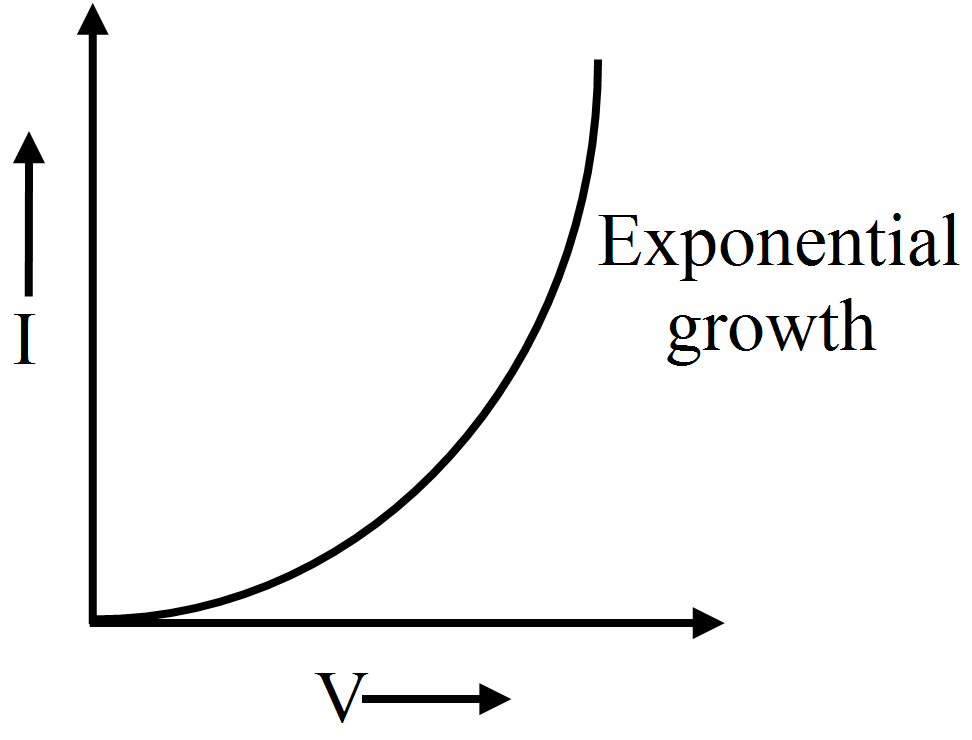
  1. If a battery is connected between terminals A and B, with positive terminal connected to point A and negative terminal connected to point B, then the diode will get forward biassed by the applied voltage. So, the current voltage graph for this circuit will be the same as that of the characteristic curves of a forward-biassed diode.
  1. If a battery is connected between terminals A and B, with positive terminal connected to point A and negative terminal connected to point B, then the upper diode will get forward biassed and the lower diode will get reverse biassed by the applied voltage. So, this lower branch can be replaced by an open circuit; hence, the current flow through this branch will be zero. The current flows only through the upper diode, so the circuit on simplification will become identical to the circuit in part (a). Hence, the current voltage graph for this circuit will be the same as that of the characteristic curves of a forward-biassed diode.

Need a full question paper?

Generate a complete, print-ready paper with questions like this in minutes — across 16+ boards, with answer keys.
Start Generating Free

Similar questions

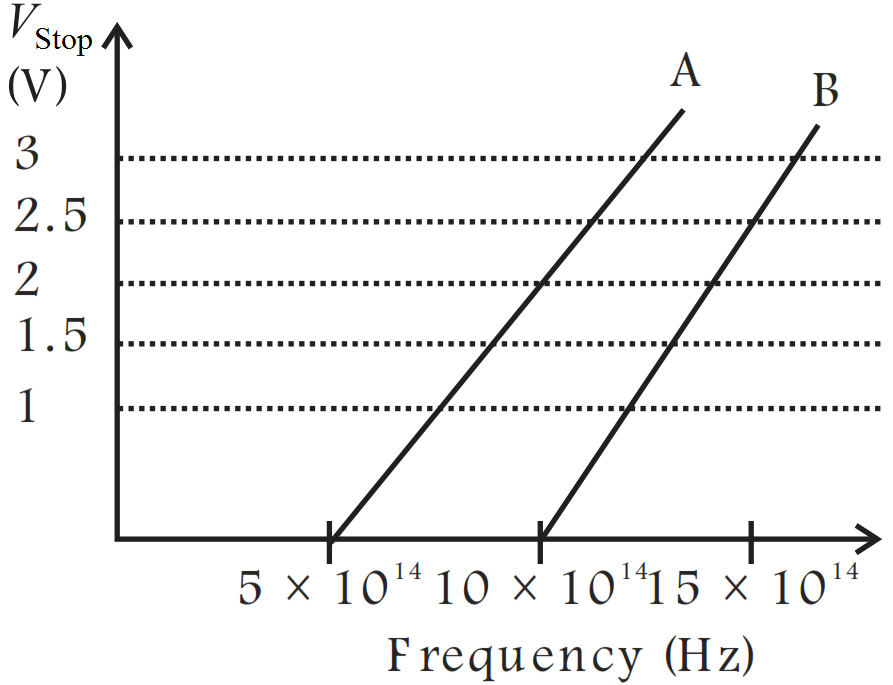
A student performs an experiment on photoelectric effect, using two materials A and B. A plot of Vstop vs ν is given in Fig.
  1. Which material A or B has a higher work function?
  2. Given the electric charge of an electron $= 1.6 \times 10^{-19}C$, find the value of h obtained from the experiment for both A and B.
Comment on whether it is consistent with Einstein’s theory:
  1. Show that the normal component of electrostatic field has a discontinuity from one side of a charged surface to another given by
$(\text{E}_2-\text{E}_1).\hat{\text{n}}=\frac{\sigma}{\in_0}$

where $\hat{\text{n}}$ is a unit vector normal to the surface at a point and σ is the surface charge density at that point. (The direction of $\hat{\text{n}}$ is from side 1 to side 2.) Hence show that just outside a conductor, the electric field is σ $\hat{\text{n}} /ε_0.$
  1. Show that the tangential component of electrostatic field is continuous from one side of a charged surface to another.
[Hint: For (a), use Gauss’s law. For, (b) use the fact that work done by electrostatic field on a closed loop is zero.]
A convex lens has a focal length of 10cm. Find the location and nature of the image if a point object is placed on the principal axis at a distance of:
  1. 9.8cm
  2. 10.2cm from the lens.
Suppose the ceiling in the previous problem is that of an elevator which is going up with an acceleration of $2.0m/s^2.$ Find the elongations.
Draw a schematic diagram of a cyclotron. Explain its underlying principle and working, stating clearly the function of the electric and magnetic fields applied on a charged particle. Deduce an expression for the period of revolution and show that it does not depend on the speed of the charged particle.
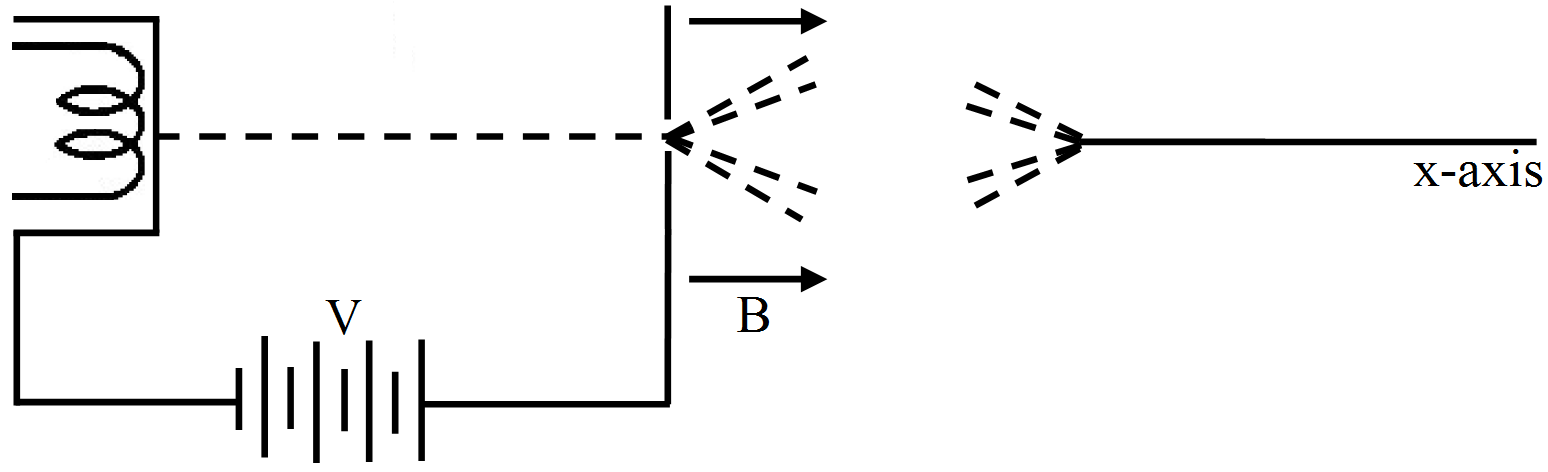
Electrons emitted with negligible speed from an electron gun are accelerated through a potential difference V along the x-axis. These electrons emerge from a narrow hole into a uniform magnetic field B directed along this axis. However, some of the electrons emerging from the hole make slightly divergent angles, as shown in the figure. Show that these paraxial electrons are refocussed on the x-axis at a distance $\sqrt{\frac{8\pi^2\text{mV}}{\text{eB}^2}}.$
Light of intensity $10^{–5}$ W $m^{–2}$ falls on a sodium photo-cell of surface area $2 cm^2.$ Assuming that the top 5 layers of sodium absorb the incident energy, estimate time required for photoelectric emission in the wave-picture of radiation. The work function for the metal is given to be about 2 eV. What is the implication of your answer?
What are the dimensions of $\chi$, the magnetic susceptibility? Consider an H-atom. Guess an expression for $\chi$, upto a constant by constructing a quantity of dimensions of $\chi$, out of parameters of the atom: e, m, v, R and $\mu _0$ . Here, m is the electronic mass, v is electronic velocity, R is Bohr radius. Estimate the number so obtained and compare with the value of $|\chi|\sim10^{-5}$ for many solid materials.
Find the typical de Broglie wavelength associated with a He atom in helium gas at room temperature (27ºC) and 1 atm pressure; and compare it with the mean separation between two atoms under these conditions.
Two audio speakers are kept some distance apart and are driven by the same amplifier system. A person is sitting at a place 6.0m from one of the speakers and 6.4m from the other. If the sound signal is continuously varied from 500Hz to 5000Hz, what are the frequencies for which there is a destructive interference at the place of the listener? Speed of sound in air = 320m/s.