Question
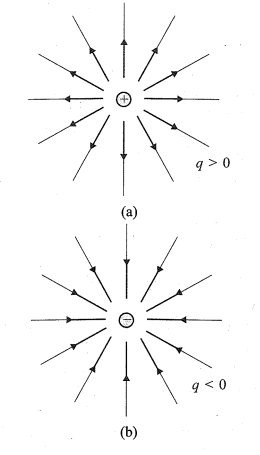
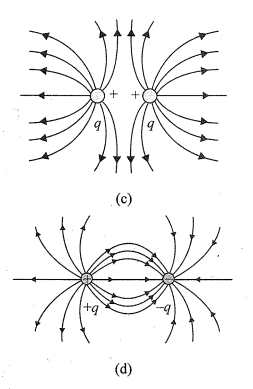
Draw the field lines of Simple electric charge distribution.

Answer

►Figure (a) shows the electric field lines for positive electric charge.
►Figure (b) shows the electric field lines for negative electric charge
►Figure (c) shows the electric field lines for two positive and equal value electric charge.
►Figure (d) shows the electric field lines for electric dipole.
Image
Image

Need a full question paper?

Generate a complete, print-ready paper with questions like this in minutes — across 16+ boards, with answer keys.
Start Generating Free

Similar questions

Find the increase in mass when 1kg of water is heated from 0°c to 100°C. Specific heat capacity of water = 4200J/kg-K.
Write magnitude and direction of force acting on poles of bar magnet placed in a magnetic field.
Discuss sign convention of distance for reflection by spherical mirror and refraction by spherical lens.
A charged particle oscillates about its mean (equilibrium) position with a frequency of $10^9Hz.$ What is the frequency of the electromagnetic waves produced by the oscillator?
A voltage of 30 V is applied across a carbon resistor with first, second and third rings of blue, black and yellow colours respectively. Calculate the value of current, in mA, through the resistor.
A man moves on a straight horizontal road with a block of mass 2kg in his hand. If he covers a distance of 40m with an acceleration of $0.5m/s^2$, find the work done by the man on the block during the motion.
Two point sources of sound are kept at a separation of 10cm. They vibrate in phase to produce waves of wavelength 5.0cm. What would be the phase difference between the two waves arriving at a point 20cm from one source-
  1. On the line joining the sources.
  2. On the perpendicular bisector of the line joining the sources?
Draw the intensity pattern for single slit diffraction and double slit interference. Hence, state two differences between interference and diffraction patterns.
A block of mass m moving at a speed v compresses a spring through a distance x before its speed is halved. Find the spring constant of the spring.
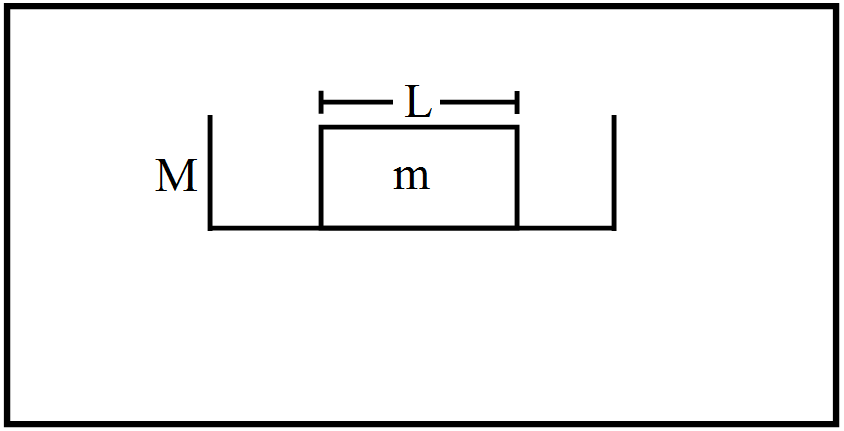
Consider a gravity-free hall in which a tray of mass M, carrying a cubical block of ice of mass m and edge L, is at rest in the middle. If the ice melts, by what distance does the centre of mass of "the tray plus the ice" system descend?