Question
Draw the graph of deviation angle $(\delta)$ versus incidence angle (i) and derive the formula for refractive index $n_{21}=\frac{\sin \left(\frac{A+D_m}{2}\right)}{\sin \left(\frac{A}{2}\right)}$ for the material of prism.
Answer


Image
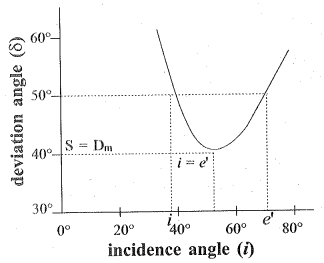
→The graph of deviation angle versus incidence angle is shown in figure.
→The graph shows that for a single value of deviation angle ( $\delta$ ) there are two values of incidence angle $i$ and hence also of $e$.
→From the symmetry it can be said that angle of deviation $\delta$ remains the same if angle of incidence $i$ and angle of emergent $e$ are interchanged. Even if the path of ray can be traced back, resulting in the same angle of deviation.
→From the graph, for a particular value of $i=e$ the angle of incidence, a single value of deviation is obtained. At the minimum deviation, $D _m$, the refracted ray becomes parallel to its base.
→So when $\delta= D _m$ and $i=e$, then $r_1=r_2$.
→For prism, $\begin{aligned} A & =r_1+r_2 \\ \therefore \quad A & =2 r_1 \\ \therefore \quad r_1 & =\frac{ A }{2}......(1)\end{aligned}$
→and from $\delta=i+e- A$,
$\begin{array}{l} D _m=2 i- A \\2 i= D _m+ A \\i=\frac{ A + D _m}{2}......(2)\end{array}$
→Applying Snell's law at incident point Q ,
$n_1 \sin i=n_2 \sin r_1$
→Substituting value of $r_1$ and $i$ from equation (1) and (2),
$\begin{array}{l}\therefore n_1 \sin \left(\frac{ A + D _m}{2}\right)=n_2 \sin \left(\frac{ A }{2}\right) \\\therefore \quad \frac{n_2}{n_1}=\frac{\sin \left(\frac{ A + D _m}{2}\right)}{\sin \frac{ A }{2}} \\\therefore \quad n_{21}=\frac{\sin \left(\frac{ A + D _m}{2}\right)}{\sin \frac{ A }{2}}\end{array}$
→which is the formula to find the refractive index of the material of the prism.

Need a full question paper?

Generate a complete, print-ready paper with questions like this in minutes — across 16+ boards, with answer keys.

Start Generating Free

Similar questions

A container contains water upto a height of 20cm and there is a point source at the centre of the bottom of the container. A rubber ring of radius r floats centrally on the water. The ceiling of the room is 2.0m above the water surface.
  1. Find the radius of the shadow of the ring formed on the ceiling if r = 15cm.
  2. Find the maximum value of r for which the shadow of the ring is formed on the ceiling. Refractive index of water $\frac{4}{3}.$
A sphere of diameter 10 cm is charged so that the electric field intensity on its surface becomes $5 \times 10^6$ Volt per meter. What will be the force exerted on a charge of $5 \times 10^{-2}$ micro Coulomb located at a distance 25 cm from the centre of the circle?
The household supply of electricity is at 220V (rms value) and 50Hz. Find the peak voltage and the least possible time in which the voltage can change from the rms value to zero.
Complete the following table:
Car Model
Driver X
Reaction time 0.20s
Driver Y
Reaction time 0.30s
A (deceleration on hard braking = 6.0m/s2)
Speed = 54km/h
Braking distance
a = ...
Total stopping distance
b = ...
Speed = 72km/h
Braking distance
c = ...
Total stopping distance
d = ...
B (deceleration on hard braking = 7.5m/s2)
Speed = 54km/h
Breaking distance
e = ...
Total stopping distance
f = ...
Speed 72km/h
Braking distance
g = ...
Total stopping distance
h = ...
A short magnet produces a deflection of 37° in a deflection magnetometer in Tan-A position when placed at a separation of 10cm from the needle. Find the ratio of the magnetic moment of the magnet to the earth's horizontal magnetic field.
A sample contains a mixture of 108Ag and 110Ag isotopes each having an activity of 8.0 × 10⁸ disintegration per second. 110Ag is known to have larger half-life than 108Ag. The activity A is measured as a function of time and the following data are obtained.
Time (s) Activity (A) (108 disinte- grations s-1)
Time (s) Activity (A) (108 disinte-grations s-1)
20 11.799 200 3.0828
40 9.1680 300 1.8899
60 7.4492 400 1.1671
80 6.2684 500 0.7212
100 5.4115    
  1. Plot ln $\Big(\frac{\text{A}}{\text{A}_0}\Big)$ versus time.
  2. See that for large values of time, the plot is nearly linear. Deduce the half-life of 110Ag from this portion of the plot.
  3. Use the half-life of 110Ag to calculate the activity corresponding to 108Ag in the first 50s.
  4. Plot In $\Big(\frac{\text{A}}{\text{A}_0}\Big)$ versus time for 108Ag for the first 50s.
  5. Find the half-life of 108Ag.
What is fundamental difference between electric dipole and magnetic dipole.
50cc of oxygen is collected in an inverted gas jar over water. The atmospheric pressure is 99.4kPa and the room temperature is 27°C. The water level in the jar is same as the level outside. The saturation vapour pressure at 27°C is 3.4kPa. Calculate the number of moles of oxygen collected in the jar.
Radio waves are produced by the accelerated motion of charges in conducting wires. Microwaves are produced by special vacuum tubes. Infrared waves are produced by hot bodies and molecules also known as heat waves. UV rays are produced by special lamps and very hot bodies like Sun.

  1. Solar radiation is:
  1. Transverse electromagnetic wave.
  2. Longitudinal electromagnetic waves.
  3. Both longitudinal and transverse electromagnetic waves.
  4. None of these.
  1. What is the cause of greenhouse effect?
  1. Infrared rays.
  2. Ultraviolet rays
  3. X-rays.
  4. Radiowaves.
  1. Biological importance of ozone layer is:
  1. It stops ultraviolet rays.
  2. It layer reduces greenhouse effect.
  3. It reflects radiowaves.
  4. None of these.
  1. Ozone is found in.
  1. Stratosphere.
  2. Ionosphere.
  3. Mesosphere.
  4. Troposphere.
  1. Earth's atmosphere is richest in.
  1. Ultraviolet.
  2. Infrared.
  3. X-rays.
  4. Microwave.
