Question
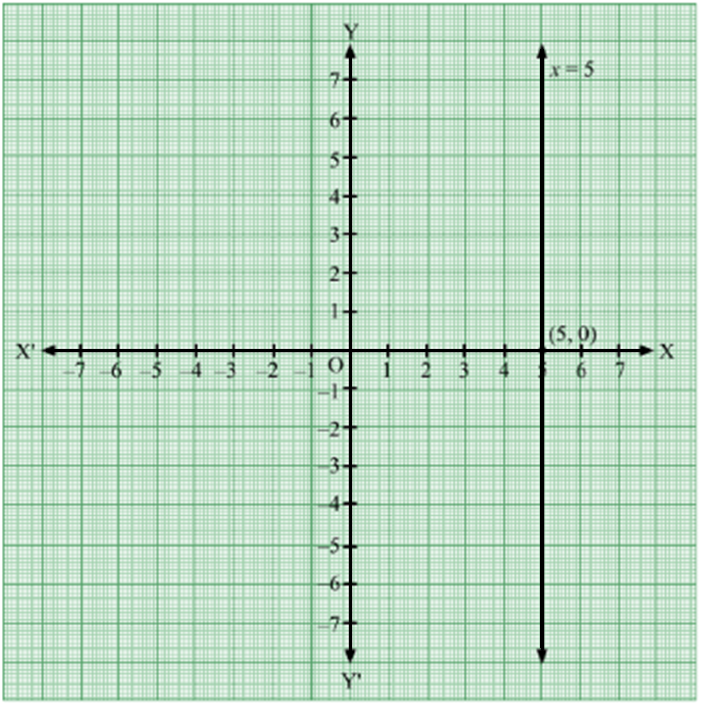
Draw the graph of the following equation. $x = 5$

Answer

The equation of given line is $x = 5$ This equation does not contain the term of $y$. So, the graph of this line parallel to $y$-axis passing through the point $(5, 0)$.

Need a full question paper?

Generate a complete, print-ready paper with questions like this in minutes — across 16+ boards, with answer keys.
Start Generating Free

Similar questions

Simplify by rationalising the denominator: $\frac{2\sqrt{6}-\sqrt{5}}{3\sqrt{5}-2\sqrt{6}}$
(Street Plan): A city has two main roads which cross each other at the centre of the city. These two roads are along the North-South direction and East-West direction. All the other streets of the city run parallel to these roads and are $200 \ m$ apart. There are $5$ streets in each direction. Using $1\ cm = 200 \ m$, draw a model of the city on your notebook. Represent the roads/streets by single lines. There are many cross- streets in your model. A particular cross-street is made by two streets, one running in the North-South direction and another in the East-West direction. Cross street is referred to in this manner: If the 2nd street running in the North-South direction and 5th in the East-West direction meet at some crossing, then we will call this cross-street $(2, 5)$. Using this convention, find: how many cross - streets can be referred to as $(3, 4).$
If $27^\text{x}=\frac{9}{3^\text{x}},$ find $x$.
Rationalise the denominator of the following: $\frac{4\sqrt{3}+5\sqrt{2}}{\sqrt{48}+\sqrt{18}}$
If both $( x -2)$ and $\left(x-\frac{1}{2}\right)$ are factors of $p x^2+5 x+r$, Show that $p = r$.
It being given that $\sqrt{2}=1.414,\sqrt{3}=1.732,\sqrt{5}=2.236$ and $\sqrt{10}=3.162,$ find the value of three places of decimals, of the following:
$\frac{2}{\sqrt{5}}$
If $x=1$ and $y=6$ is a solution of the equation $8 x-a y+a^2=0$, find the values of $a$.
Prove that: $\bigg[7\Big\{(81)^\frac{1}{4}+(256)^\frac{1}{4}\Big\}^\frac{1}{4}\bigg]^4=16807$
A rectangular container, whose base is a square of side $5\ cm$, stands on a horizontal table, and holds water up to $1\ cm$ from the top.
When a solid cube is placed in the water it is completely submerged, the water rises to the top and $2$ cubic cm of water overflows.
Calculate the volume of the cube and also the length of its edge.
If the diagonals of a quadrilateral bisect each other, then it is a parallelogram.