Question
Draw the graph of the following linear equations in two variables: $x + y = 4$
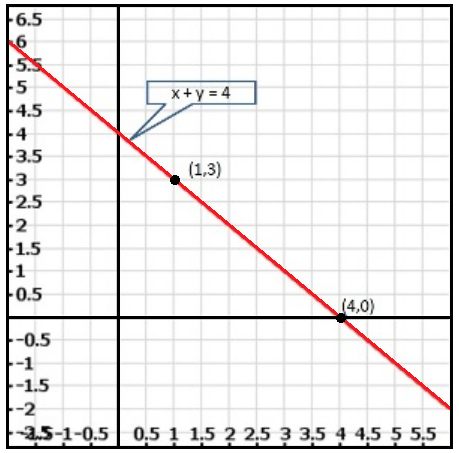
Answer

We have, $x + y = 4$
$\Rightarrow x = 4 - y ...(i)$
Putting $y = 0$,
we get $x = 4 - 0 = 4$
Putting $y = 3,$
we get $x = 4 - 3 = 1$
Thus, we have the following table giving two points on the line represented by the equation $x + y = 4$:
Graph of the equation $x + y = 4$:

Need a full question paper?

Generate a complete, print-ready paper with questions like this in minutes — across 16+ boards, with answer keys.

Start Generating Free

Similar questions

Show that the quadrilateral formed by joining the mid-points of the consecutive sides of a square is also a square.
Expenditure on Education of a country during a five year period ($2002-2006$), in crores of rupees, is given below:
Elementary education
Secondary Education
University Education
Teacher’s Training
Social Education
Other Educational Programmes
Cultural programmes
Technical Education
$240$
$120$
$190$
$20$
$10$
$115$
$25$
$125$
Represent the information above by a bar graph.
Suppose you are given a circle. Give a construction to find its centre.
Write the class size and class limits in the following: $104, 114, 124, 134, 144, 154$ and $164$.
The following table shows the favourite sports of 250 students of a school. Represent the data by a bar graph.
Sports
Cricket
Football
Tennis
Badminton
Swimming
Number of students
$75$
$35$
$50$
$25$
$65$
Express in the form of $\frac{\text{p}}{\text{q}}:0.\overline{38}+1.\overline{27}.$
Two chords $AB, CD$ of lengths $5\ cm, 11\ cm$ respectively of a circle are parallel. If the distance between $AB$ and $CD$ is $3\ cm$, find the radius of the circle.
$ABCD$ is a square $E, F, G$ and $H$ are points on $AB, BC, CD,$ and $DA$ respectively, such that $AE = BF = DH$. prove that $EFGH$ is a square.
Visualize the representation of $3.765$ on the number line using successive magnification.
In a triangle, $P, Q$ and $R$ are the mid points of sides $BC, CA$ and $AB$ respectively. If $AC = 21\ cm, BC = 29\ cm$ and $AB = 30\ cm$, find the perimeter of the quadrilateral $ARPQ$.