Question
Draw the graph of the following linear equations in two variables:
y = 2x

Answer

We have,
y = 2x ...(i)
Putting x = 0, we get y = 2 × 0 = 0
Putting x = 1, we get y = 2 × 1 = 2
Thus, we have the following table giving two points on the line represented by the equation y = 2x:
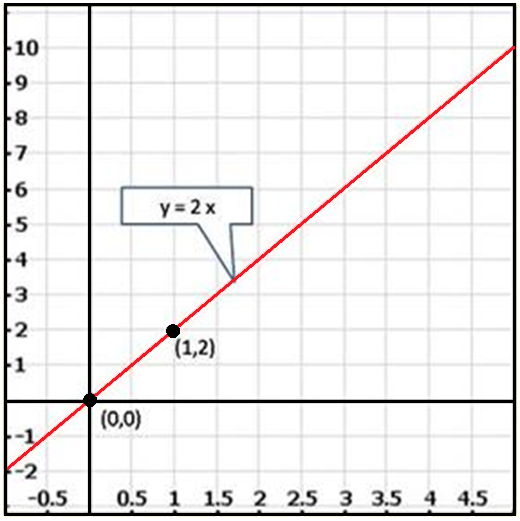
Graph of the equation y = 2x:

Need a full question paper?

Generate a complete, print-ready paper with questions like this in minutes — across 16+ boards, with answer keys.
Start Generating Free

Similar questions

A triangle has sides 35cm, 54cm, 61cm long. Find its area. Also, find the smallest of its altitudes.
In the adjoining figure, ABCD is a parallelogram in which $\angle\text{A}=70^{\circ}.$ Calculate $\angle\text{B},\angle\text{C}$ and $\angle\text{D}.$
Find the median of the following data: 41, 43, 127, 99, 61, 92, 71, 58, 57. If 58 is replaced by 85, what will be the new median?
Factorize: $a(a + b)^3 - 3a^2b(a + b)$
The angles of a triangle are arranged in ascending order of magnitude. If the difference between two consecutive angles is 10°, find the three angles.
The inner diameter of a cylindrical wooden pipe is $24cm$ and its outer diameter is $28cm.$ The length of the pipe is $35cm.$ Find the mass of the pipe, if $1\ cm^3$ of wood has a mass of $0.6g.$
Factorize the following expressions:
$\Big[\frac{\text{x}}{2}+\text{y}+\frac{\text{z}}{3}\Big]^3+\Big[\frac{\text{x}}{3}-\frac{2\text{y}}{3}+\text{z}\Big]^3+\Big[-\frac{5\text{x}}{6}-\frac{\text{y}}{3}-\frac{4\text{z}}{3}\Big]^3$
For any positive real number x, write the value of $\big\{(\text{x}^\text{a})^\text{b}\big\}^{\frac{1}{\text{ab}}}\big\{(\text{x}^\text{b})^\text{c}\big\}^{\frac{1}{\text{bc}}}\big\{(\text{x}^\text{c})\text{a}\big\}^{\frac{1}{\text{ca}}}$
Three vertices of a rectangle ABCD are A(3, 1), B(-3, 1) and C(-3, 3). plot these points on a graph paper and find the coordinates of the fourth vertex D. Also find the area of rectangle ABCD.
Find the value of the following correct to three place of decimals, it begin that $\sqrt2=1.4142, \sqrt3=1.732,\ \sqrt5=2.2360,\ \sqrt6=2.4495$ and $\sqrt{10}=3.162.$
$\frac{1+\sqrt2}{3-2\sqrt2}$