Question
Draw the intensity pattern for single slit diffraction and double slit interference. Hence, state two differences between interference and diffraction patterns.
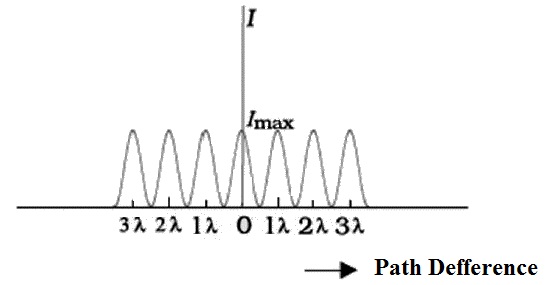
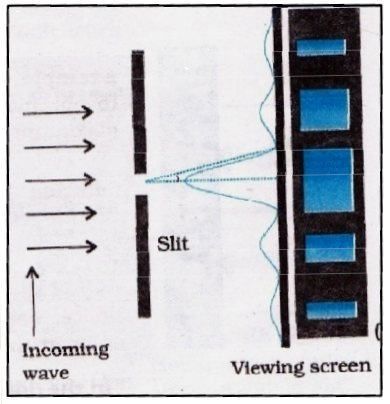
Answer

Interference Diffraction
All maxima have equal intensity. Maxima have different (/rapidly decreasing) intensity.
All fringes have equal width. Different (/changing) width.
Superposition of two wavefronts. Superposition of wavelets from the same wavefront.

Need a full question paper?

Generate a complete, print-ready paper with questions like this in minutes — across 16+ boards, with answer keys.

Start Generating Free

Similar questions

  1. Write two characteristics of a material used for making permanent magnets.
  2. Why is core of an electromagnet made of ferromagnetic materials?
Can we measure the potential difference across an unbiased p–n junction by connecting a sensitive voltmeter across it?
In some old texts it is mentioned that $4\pi$ lines of force originate from each unit positive charge. Comment on the statement in view of the fact that $4\pi$ is not an integer.
Three charges $-q, Q$ and $-q$ are situated at equal distances in a straight line. If the total potential energy of the system of all three charges is zero, then what will be the value of ratio $Q : q$ ?
A compound microscope forms an inverted image of an object. In which of the following cases it is kely to create difficulties?
  1. Looking at small germs.
  2. Looking at circular spots.
  3. Looking at a vertical tube containing some water.
Two point charges $4\mu\text{C}$ and $-2 \mu\text{C}$  are separated by a distance of 1 m in air. Calculate at what point on the line joining the two charges is the electric potential zero.
Write characteristics of electro magnetic waves.
The coil of a moving-coil galvanometer keeps on oscillating for a long time if it is deflected and released. If the ends of the coil are connected together, the oscillation stops at once. Explain
A cylindrical metal tube has a length of $50\ cm$ and is open at both ends. Find the frequencies between $1000\ Hz$ and $2000\ Hz$ at which the air column in the tube can resonate. Speed of sound in air is $340\ m/s.$
Show that the interior of a conductor can have no excess charge in the static situation.