Question
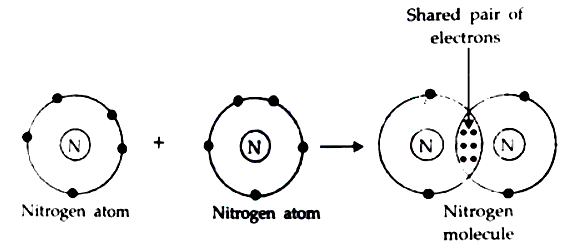
Draw the orbit structure of the following:
$N_2$

Answer

orbit structure of $N_2$ :

Need a full question paper?

Generate a complete, print-ready paper with questions like this in minutes — across 16+ boards, with answer keys.

Start Generating Free

Similar questions

Distinguish between the saturated hydrocarbon ethane and the unsaturated hydrocarbon ethene by drawing their structural formulae.
Explain, why electrolysis is an example of redox reaction?
From the equation :
$C + 2H_2SO_4 \rightarrow CO_2 + 2H_2O + 2SO_2$
Calculate:
$(i)$ The mass of carbon oxidized by $49g$ of sulphuric acid $(C = 12,$ relative molecular mass of sulphuric acid $= 98)$
$(ii)$ The volume of sulphur dioxide measured at $\text{STP},$ liberated at the same time.
When heated, potassium permanganate decomposes according to the following equation $:2KMnO_4 \rightarrow K_2MnO_4+ MnO_2 + O_2$
Given that the molecular mass of potassium permanganate is $158g,$ what volume of oxygen $($measured at room temperature$)$ would be obtained by the complete decomposi tion of $15.8g$ of potassium permanganate?
$($Molar volume at room temperature is $24$ litres$). [K = 39, Mn = 55, 0 = 16 ]$
Copy and complete the following table which refers to the action of heat on some carbonates :
CarbonateColour of residue on cooling
Zinc carbonate
Lead carbonate
Copper carbonate
Explain the following briefly:
Helium does not form $He_2$​​​​​​​ molecule
An aqueous solution of sodium chloride is not used for electrolytic reduction of sodium metal. Why?
X, Y, and Z are three crystalline solids that are soluble in water and have common anion. To help you to identify X, Y and Z you are provided with the following experimental observations. Copy and complete the corresponding inferences in (a) to (e).
(a) A reddish-brown gas is obtained when X, Y, and Z are separately warmed with concentrated sulphuric acid and copper turning added to the mixture.
Inference 1: The common anion is _____ion.
(b) When X is heated, it melts and gives off only one gas which re-lights a glowing splint.
Inference2: The cation in X is either _____ or _____.
(c) The action of heat on Y produces a reddish-brown gas and yellow residue which fuses with a glass of the test tube.
Inference3: The metal ion present in Y is the____ ion.
(d) When Z is heated, it leaves no residue. Warming Z with sodium hydroxide solution liberates a gas that turns moist red litmus paper blue.
Inference4: Z contains the ____ cation.
(e) Write the equations for the following reactions:
  1. X and concentrated sulphuric acid (below $200^oC$). (One equation only for either of the cations given in Inference 2)
  2. The action of heat on Y.
  3. Concentrated nitric acid is added to copper turnings kept in a beaker.
What volume of hydrogen and oxygen measured at S.T.P. will be required to prepare 1.8 g of water?
The following is a list of methods for the preparation of salts.
A – direct combination of two elements
B – reaction of a dilute acid with a metal.
C – reaction of a dilute acid with an insoluble base.
D – titration of a dilute acid with a solution of soluble base.
E – reaction of two solutions of salts to form a precipitate.
Choose from the above list A to E, the best method of preparing the following salts by giving a suitable equation in each case:
1. Anhydrous ferric chloride,
2. Lead chloride,
3. Sodium sulphate.
4. Copper sulphate.