Question
Draw the structures of polar isomers of $\left[ Co ( e )_3\right]^{3+}$

Answer

Get the step-by-step solution for this question inside the Vidyadip app.

Get the answer in the app

Need a full question paper?

Generate a complete, print-ready paper with questions like this in minutes — across 16+ boards, with answer keys.
Start Generating Free

Similar questions

Arrange the following in decreasing order of their acidic strength. Give explanation for the arrangement.
C6H5COOH, FCH2COOH, NO2CH2COOH
Write the reaction of $t$-butyl methyl ether with conc. HI and also explain its mechanism.
Explain three differences between the rate constant of reaction and rate of a reaction.
How can you determine the rate law of the following reaction?
$2\text{NO}(\text{g})+\text{O}_2(\text{g})\xrightarrow{\ \ \ \ \ }2\text{NO}_2(\text{g})$
The rate constant for the decomposition of hydrocarbons is 2.418 × 10–5s–1 at 546 K. If the energy of activation is 179.9 kJ/mol, what will be the value of pre-exponential factor.
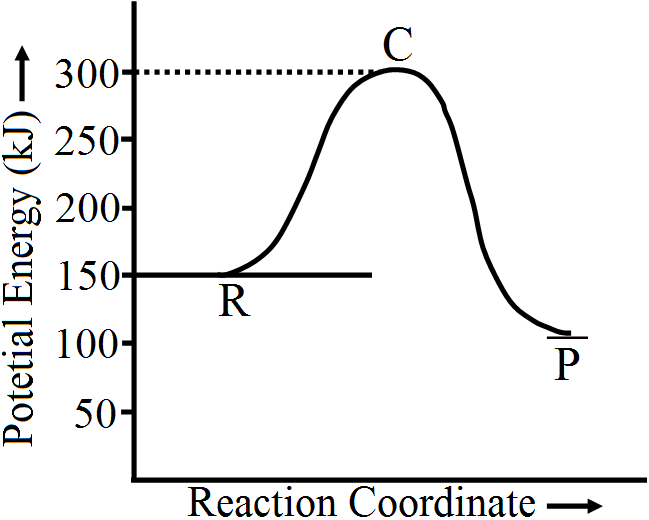
Answer the following questions on the basis of the given plot of potential energy vs reaction coordinate:

  1. What is the threshold energy for the reaction?
  2. What is the activation energy for forward reaction?
  3. What is the activation energy for backward reaction?
  4. What is enthalpy change for the forward reaction?

Give the structures of A, B and C in the following reaction:
$\text{C}_6\text{H}_5\text{NO}_2\xrightarrow[]{\text{Fe}/\text{HCl}}\text{A}\xrightarrow[273\text{K}]{\text{HNO}_2}\text{B}\xrightarrow[]{\text{C}_6\text{H}_5\text{OH}}\text{C}$
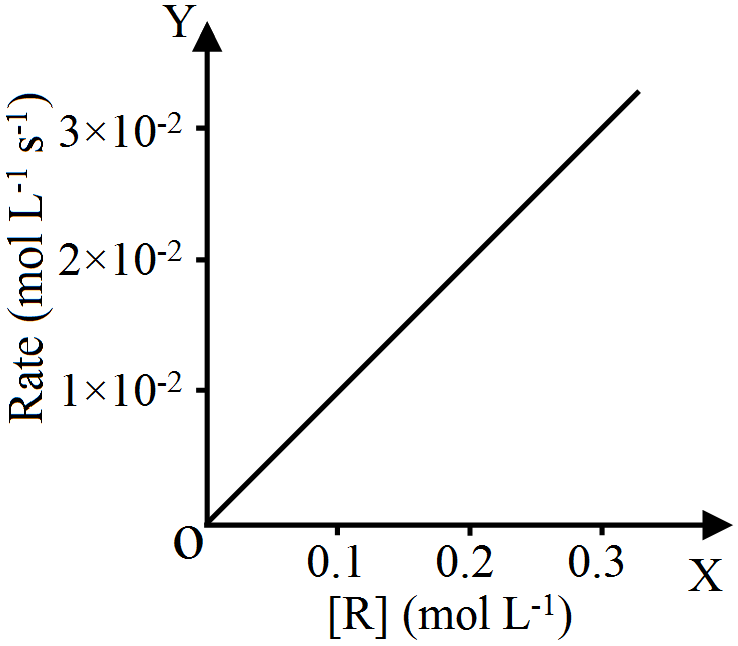
The rate for the reaction R→P is rate = k[R]. It has been shown graphically below. What is rate constant for the reaction?

Predict which of the following will be coloured in aqueous solution? Ti3+, V3+, Cu+, Sc3+, Mn2+, Fe3+ and CO2+. Give reasons for each.
Give reasons for the following observations:

The treatment of alkyl chloride with aqueous KOH leads to the formation of alcohol but in the presence of alcoholic KOH, alkene is the major product.