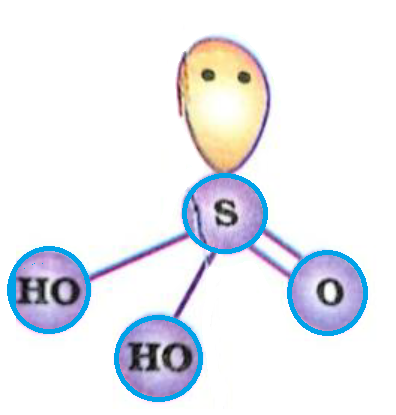
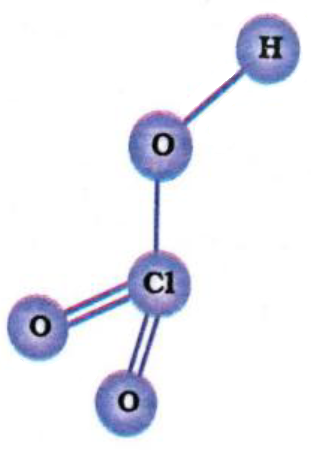
Question
Draw the structures of the following:
  1. $\mathrm{H}_2 \mathrm{SO}_3$
  2. $\mathrm{HClO}_3$

Answer

  1.  
  1.  

Need a full question paper?

Generate a complete, print-ready paper with questions like this in minutes — across 16+ boards, with answer keys.

Start Generating Free

Similar questions

Give the structures of A, B and C in the following reaction: $\text{C}_6\text{H}_5\text{NO}_2\xrightarrow[]{\text{Fe}/\text{HCl}}\text{A}\xrightarrow[273\text{K}]{\text{HNO}_2}\text{B}\xrightarrow[]{\text{C}_6\text{H}_5\text{OH}}\text{C}$
Describe the principle controlling each of the following processes:
  1. Vapour phase refining of titanium metal.
  2. Froth flotation method of concentration of a sulphide ore.
State two main functions of carbohydrates.
An organic compound $X \left( C _4 H _{10} O \right)$ reacts with HCl giving a compound $Y \left( C _4 H _9 Cl \right)$ which on reduction gives butane. Oxidation of compound $X$ gives carbonyl compound $Z$ and then the carboxylic acid of the same number of carbons formed. Give the formula of $X, Y, Z$ and $P$ and also write the reaction sequence.
How can you separate alumina from silica in a bauxite ore associated with silica? Give equations, if any.
Compare the chemistry of the actinoid with that of lanthanoids with reference to:
Oxidation states.
For the reaction
$2NO_{(g)} + Cl_{2(g)} → 2 NOCl_{(g)}$
The following data were collected. All the measurements were taken at $263K:$
Experiment. No. Initial [NO] (M) Initial $[Cl_2]\ (M)$ Initial rate of disappearance of $Cl_2$(M/min)
$1$ $0.15$ $0.15$ $0.60$
$2$ $0.15$ $0.30$ $1.20$
$3$ $0.30$ $0.15$ $2.40$
$4$ $0.25$ $0.25$ $?$
  1. Write the expression for rate law.
  2. Calculate the value of rate constant and specify its units.
  3. What is the initial rate of disappearance of $Cl_2$ in exp. $4?$
Niobium crystallises in body-centred cubic structure. If density is $8.55 \mathrm{~g} \mathrm{~cm}^{-3}$, calculate atomic radius of niobium using its atomic mass 93 u.
Alcohols react both as nucleophiles as well as electrophiles. Write one reaction of each type and describe its mechanism.
What are LDPE and HDPE? How are they prepared?