- An atomic electron is ejected.
- An electron which is already present within the nucleus is ejected.
- A neutron in the nucleus decays emitting an electron.
- A proton in the nucleus decays emitting an electron.
Explanation:
Negative beta decay is given as
$\text{n}\rightarrow\text{p + e}^-+\bar{\text{v}}$
Neutron decays to produce proton, electron and anti-neutrino.
Generate a complete, print-ready paper with questions like this in minutes — across 16+ boards, with answer keys.
What causes changes in the colours of the soap or oil films for the given beam of light
|
(a) Angle of incidence |
|
(b) Angle of reflection |
|
(c) Thickness of film |
|
(d) None of these |
The minimum wavelength of X-rays produced by electrons accelerated by a potential difference of volts is equal to
|
(a) |
(b) |
(c) |
(d) |
If
undergoes successively 8 a-decays and 6 b-decays, then resulting nucleus is
|
(a) |
(b) |
(c) |
(d) |
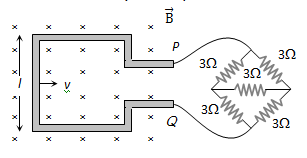
A square metallic wire loop of side 0.1 m and resistance of 1W is moved with a constant velocity in a magnetic field of 2 wb/m2 as shown in figure. The magnetic field is perpendicular to the plane of the loop, loop is connected to a network of resistances. What should be the velocity of loop so as to have a steady current of 1mA in loop

|
(a) 1 cm/sec |
(b) 2 cm/sec |
(c) 3 cm/sec |
(d) 4 cm/sec |
Two similar coils are kept mutually perpendicular such that their centres coincide. At the centre, find the ratio of the magnetic field due to one coil and the resultant magnetic field by both coils, if the same current is flown
|
(a) 1: |
(b) 1 : 2 |
(c) 2 : 1 |
(d) |
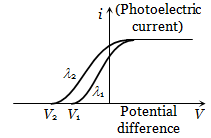
In the following diagram if V2 > V1 then

|
(a) |
(b) |
(c) |
(d) |
The combination of capacitors with and
is charged by connecting AB to a battery. Consider the following statements
I. Energy stored in = Energy stored in
+ Energy stored in
II. Charge on C1 = Charge on C2 + Charge on C3
III. Potential drop across C1 = Potential drop across C2 = Potential drop across C3
Which of these is/are correct
|
(a) I and II |
(b) II only |
(c) I and III |
(d) III only |
The angle of polarisation for any medium is 60o, what will be critical angle for this
|
(a) |
(b) |
(c) |
(d) |