Question
During a total solar eclipse the moon almost entirely covers the sphere of the sun. Write the relation between the distances and sizes of the sun and moon.
Answer

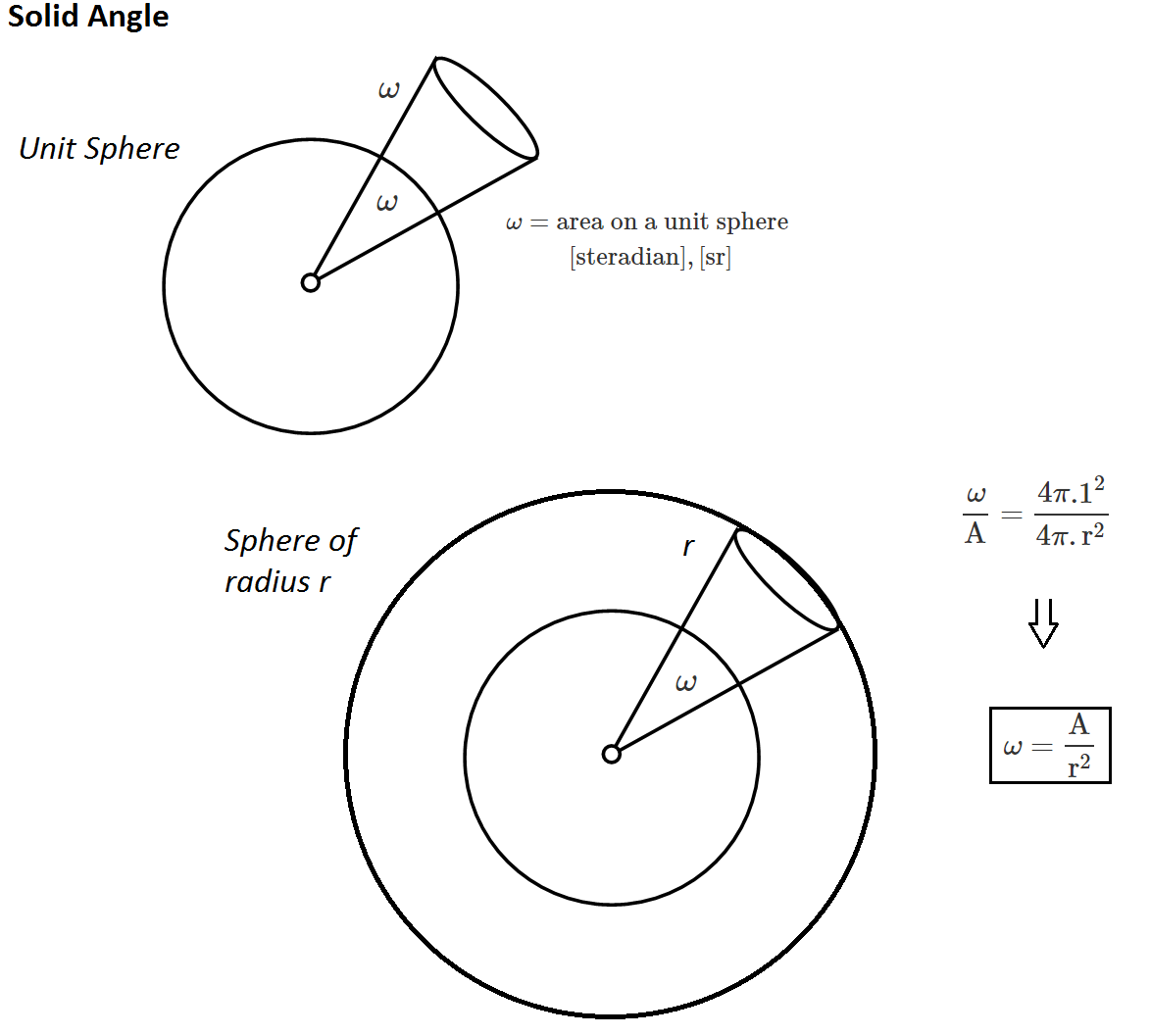
Key point: In geometry, a solid angle (symbol: $\Omega$ or w) is the two­dimensional angle in three-dimensional space that an object subtends at a point. It is a measure of how large the object appears to an observer looking from that point. In the International System of Units (SI), a solid angle is expressed in a dimensionless unit called a steradian (symbol: sr).

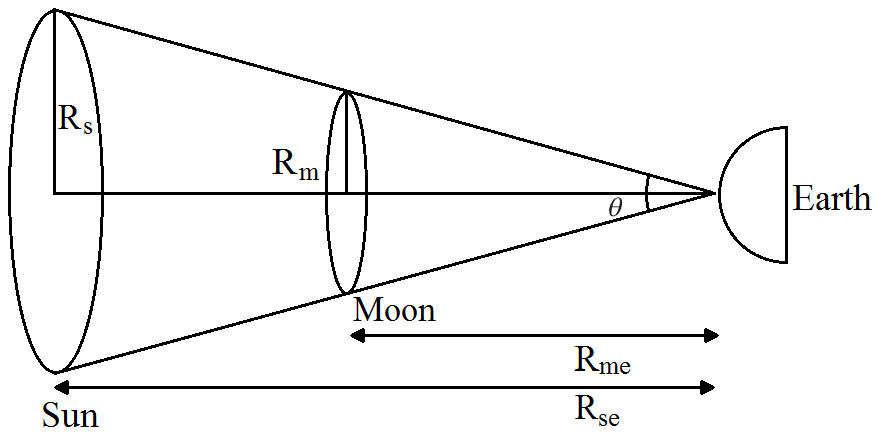
A small object nearby may subtend the solid angle as a larger object farther away. For example, although the Moon is much smaller than the Sun, it is also much closer to Earth. Diagram given below shows that moon almost entirely covers the sphere of the sun. $R_{me}$ = Distance of moon from earth $R_{se}$ = Distance of sun from earth Let the solid angle made by sun and moon is $\text{d}\Omega,$ we can write

$\text{d}\Omega=\frac{\text{A}_\text{sun}}{\text{R}^2_\text{se}}=\frac{\text{A}_\text{moon}}{\text{R}^2_\text{me}}$
Here, $A_{sun}$ = Area of the sun $A_{moon}$ = Area of the moon$\Rightarrow\theta=\frac{\pi\text{R}_\text{s}^2}{\text{R}_\text{se}^2}=\frac{\pi\text{R}_\text{m}^2}{\text{R}_\text{me}^2}$
$\Rightarrow\Big(\frac{\text{R}_\text{s}}{\text{R}_\text{se}}\Big)^2=\Big(\frac{\text{R}_\text{m}}{\text{R}_\text{me}}\Big)^2$
$\Rightarrow\frac{\text{R}_\text{s}}{\text{R}_\text{se}}=\frac{\text{R}_\text{m}}{\text{R}_\text{me}}\ \text{or}\ \frac{\text{R}_\text{s}}{\text{R}_\text{m}}=\frac{\text{R}_\text{se}}{\text{R}_\text{me}}$
(Here, radius of sun and moon represent their sizes respectively)

Need a full question paper?

Generate a complete, print-ready paper with questions like this in minutes — across 16+ boards, with answer keys.

Start Generating Free

Similar questions

Prove that when the vector sum of all external forces acting on a system is zero, then the center of mass remains constant.
In an experiment on the specific heat of a metal, a 0.20 kg block of the metal at $150^{\circ} \mathrm{C}$ is dropped in a copper calorimeter (of water equivalent 0.025 kg ) containing $150 \mathrm{~cm}^3$ of water at $27^{\circ} \mathrm{C}$. The final temperature is $40^{\circ} \mathrm{C}$. Compute the specific heat of the metal. If heat losses to the surroundings are not negligible, is your answer greater or smaller than the actual value for specific heat of the metal?
A steel tape $1m$ long is correctly calibrated for a temperature of $27.0°C$. The length of a steel rod measured by this tape is found to be $63.0cm$ on a hot day when the temperature is $450°C$. What is the actual length of the steel rod on that day? What is the length of the same steel rod on a day when the temperatures $27.0°C$? Coefficient of linear expansion of steel = $1.20 \times 10^{–5} K^{–1}$.
A thin rod having length $L_0$ at $0°C$ and coefficient of linear expansion $\alpha$ has its two ends maintained at temperatures $\theta_1$ and $\theta_2,$ respectively. Find its new length.
Explain the following rule of vector combination: (i) Triangle law of vector addition. (ii) Polygon law of vector addition
A pin of length $2.00cm$ is placed perpendicular to the principal axis of a converging lens. An inverted image of size $1.00cm$ is formed at a distance of $40.0cm$ from the pin. Find the focal length of the lens and its distance from the pin.
Estimate the mean free path and collision frequency of a nitrogen molecule in a cylinder containing nitrogen at 2.0 atm and temperature 17°C. Take the radius of a nitrogen molecule to be roughly $1.0\mathring{\text{A}}$ Compare the collision time with the time the molecule moves freely between two successive collisions (Molecular mass of $N^2 = 28.0u$).
A wire of length $10cm$ translates in a direction making an angle of $60°$ with its length. The plane of motion is perpendicular to a uniform magnetic field of $1.0T$ that exists in the space. Find the emf induced between the ends of the rod if the speed of translation is $20cm/s^{-1}$.
Two small spheres, each having a mass of 20g, are suspended from a common point by two insulating strings of length 40cm each. The spheres are identically charged and the separation between the balls at equilibrium is found to be 4cm. Find the charge on each sphere.
What is the difference between series and parallel combination of spring springs? Obtain an expression for the effective spring constant in each combination.