MCQ
During $\beta^-$ emission:
  • A
    A neutron in the nucleus decays emitting an electron.
  • B
    An atomic electron is ejected.
  • C
    A part of the binding energy of the nucleus is converted into an electron.
  • D
    A proton in the nucleus decays emitting an electron.

Answer

  1. A neutron in the nucleus decays emitting an electron.

Explanation:

$\beta^-$ emission is due to decay of neutron in the nucleus n → p + e.

Need a full question paper?

Generate a complete, print-ready paper with questions like this in minutes — across 16+ boards, with answer keys.

Start Generating Free

Similar questions

If an element X has mass number and number of proton 8 then identify element X :
A coil of 40 turns and area $4 cm^2$ is suddenly removed from a magnetic field. Charge of $2 \times 10^{-4} C$ flows through it. If its resistance is 80 ohms, then magnetic flux density is:

Given a point source of light, which of the following can produce a parallel beam of light

(a) Convex mirror

(b) Concave mirror

(c) Concave lens

(d) Two plane mirrors inclined at an angle of 90°

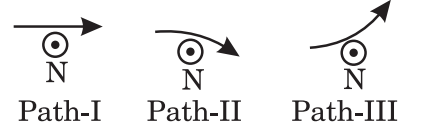
In the given figures, three paths of an $\alpha$-particle passing nearby a nucleus (N) are shown. Among these, which path will be correct?
Image

An electric field of 1500 V / m and a magnetic field of  0.40 weber / meter2 act on a moving electron. The minimum uniform speed along a straight line the electron could have is

(a) 1.6  × 1015 m / s

(b) 6 × 10-16 m / s

(c) 3.75 × 10³ m / s

(d) 3.75 × 10² m / s

In an isolated parallel plate capacitor of capacitance C, the four surface have charges  and  as shown. The potential difference between the plates is

(a)

(b) 

(c)

(d)

Cathode rays are passing through a discharge tube. In the tube, there is:

The time period of a vibration magnetometer is T0. Its magnet is replaced by another magnet whose moment of inertia is 3 times and magnetic moment is 1/3 of the initial magnet. The time period now will be

(a) 3T0

(b) T0

(c)  

(d) T0/3

A zone plate of focal length 60 cm, behaves as a convex lens, If wavelength of incident light is 6000,  then radius of first half period zone will be

(a) 36  

(b) 6  

(c)  

(d) 6  

Let the magnetic field on earth be modelled by that of a point magnetic dipole at the centre of earth. The angle of dip at a point on the geographical equator: