MCQ
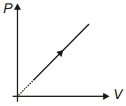
During the thermodynamic process shown in figure for an ideal gas
  • A
    $\Delta T=0$
  • B
    $\Delta Q=0$
  • C
    $W < 0$
  • $\Delta U > 0$

Answer

Correct option: D.
$\Delta U > 0$
d
(d)

For a straight $P-V$ graph line $P \propto V$

If pressure increases, volume increases then $T$ also increases $[P V \propto T]$

So $\Delta T \neq 0$

Volume increasing so work is positive, $W > 0$

and temperature also increasing so $\Delta Q > 0$

$\because \Delta Q=\Delta U+\Delta W$

So $\Delta U > 0$
Need a full question paper?

Generate a complete, print-ready paper with questions like this in minutes — across 16+ boards, with answer keys.

Start Generating Free

Similar questions

A heavy object has $.......$ gravitational potential energy than a lighter one.
The pitch of an organ pipe is highest when the pipe is filled with
A bar of iron is $10\, cm$ at $20°C$. At $19°C$ it will be ($\alpha$ of iron $= 11 \times 10^{-6}/°C$)
When an object covers equal distances in equal time intervals, then its speed is:
A air bubble of radius $1\,cm$ in water has an upward acceleration $9.8\, cm\, s ^{-2}$. The density of water is $1\, gm\, cm ^{-3}$ and water offers negligible drag force on the bubble. The mass of the bubble is$.......gm$

$\left( g =980 \,cm / s ^{2}\right)$

A plane wave $y=A\,\, sin\,\, \omega \left( {t - \frac{x}{v}} \right)$ undergo a normal incidence on a plane boundary separating medium $M_1$ and $M_2$ and splits into a reflected and transmitted wave having speeds $v_1$ and $v_2$ then
The $x$ and $y$ coordinates of the particle at any time are $x = 5t - 2t^2$ and $y = 10t$ respectively, where $x$ and $y$ are in metres and $t$ in seconds. The acceleration of the particle at $t = 2\, s$ is......$m/sec^2$
A star is modeled as a uniform spherical distribution of matter keeping mass of star constant. How gravitational pressure on surface depends on volume of the star?
A rod of mass $M$ and length $L$ is placed in a horizontal plane with one end hinged about the vertical axis. A horizontal force of $F=\frac {Mg}{2}$ applied at a distance $\frac {5L}{6}$ from the hinged end. The angular acceleration of the rod will be
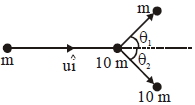
A particle of mass $m$ is moving along the $x$ -axis with initial velocity $u \hat i$. It collides elastically with a particle of mass $10\, m$ at rest and then moves with half its initial kinetic energy (see figure). If $\sin \theta_{1}=\sqrt{n} \sin \theta_{2}$ then value of $n$ is.....