Question

Dynamo core is laminated because

(a) Magnetic field increases

(b) Magnetic saturation level in core increases

(c) Residual magnetism in core decreases

(d) Loss of energy in core due to eddy currents decreases

Answer

(d) Loss of energy in core due to eddy currents decreases

Need a full question paper?

Generate a complete, print-ready paper with questions like this in minutes — across 16+ boards, with answer keys.

Start Generating Free

Similar questions

When water droplets merge to form a bigger drop:
  1. Energy is liberated.
  2. Energy is absorbed.
  3. Energy is neither liberated nor absobred.
  4. Energy may either be liberated or absorbed depending on the nature of the liquid.
When a coil of cross-sectional area A and number of turns N is rotated in a uniform magnetic field B with angular velocity $\omega$ then the maximum emf induced in the coil will be.

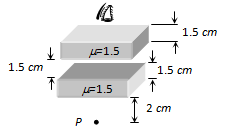
The image of point P when viewed from top of the slabs will be

(a) 2.0 cm above P

(b) 1.5 cm above P

(c) 2.0 cm below P

(d) 1 cm above P

The largest wavelength in the ultraviolet region of the hydrogen spectrum is 122nm. The smallest wavelength in the infrared region of the hydrogen spectrum (to the nearest integer) is?
Which of the following is/are optoelectronic devices?

Due to 10 ampere of current flowing in a circular coil of 10 cm radius, the magnetic field produced at its centre is 3.34 . The number of turns in the coil will be

(a) 5000  

(b) 100

(c) 50       

(d) 25

A magnetic needle lying parallel to a magnetic field requires W units of work to turn it through 60°. The torque required to maintain the needle in this position will be

(a)  

(b) W

(c)  

(d) 2W

An inductor, a resistor and a capacitor are joined in series with an AC source. As the frequency of the source is slightly increased from a very low value, the reactance.

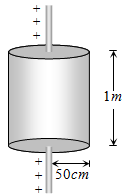
Electric charge is uniformly distributed along a long straight wire of radius 1mm. The charge per cm length of the wire is Q coulomb. Another cylindrical surface of radius 50 cm and length 1m symmetrically encloses the wire as shown in the figure. The total electric flux passing through the cylindrical surface is

(a)         

(b)

(c)

(d)