MCQ
Dynamo is a device for converting
  • A
    Electrical energy into mechanical energy
  • Mechanical energy into electrical energy
  • C
    Chemical energy into mechanical energy
  • D
    Mechanical energy into chemical energy

Answer

Correct option: B.
Mechanical energy into electrical energy
 Mechanical energy into electrical energy

Need a full question paper?

Generate a complete, print-ready paper with questions like this in minutes — across 16+ boards, with answer keys.
Start Generating Free

Similar questions

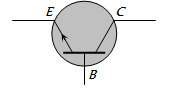
The symbol given in figure represents
In an insulator, the forbidden energy gap between valence band and conduction band is of the following order :
A solenoid has an inductance of 60 henrys and a resistance of 30 ohms. If it is connected to a 100 volt battery, how long will it take for the current to reach $\frac{e-1}{e} \approx 63.2 \%$ of its final value
A person can see clearly only upto a distance of 25 cm. He wants to read a book placed at a distance of 50 cm. What kind of lens does he require for his spectacles and what must be its power
The capacitance of a spherical condenser is $1\,\mu F$. If the spacing between the two spheres is $1\,mm$, then the radius of the outer sphere is
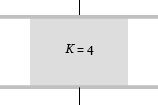
Consider a parallel plate capacitor of $10\,\mu \,F$ (micro-farad) with air filled in the gap between the plates. Now one half of the space between the plates is filled with a dielectric of dielectric constant $4$, as shown in the figure. The capacity of the capacitor changes to.......$\mu \,F$
An electromagnetic wave travelling in the $x-$ direction has frequency of $2 \times 10^{14}\,Hz$ and electric field amplitude of $27\,Vm^{-1}$ . From the options given below, which one describes the magnetic field for this wave ?
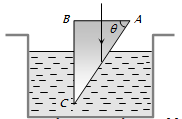
A glass prism (μ = 1.5) is dipped in water (μ = 4/3) as shown in figure. A light ray is incident normally on the surface AB. It reaches the surface BC after totally reflected, if
A moving coil sensitive galvanometer gives at once much more deflection. To control its speed of deflection
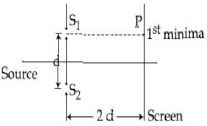
Consider a Young’s double slit experiment as shown in figure. What should be the slit separation $d$ in terms of wavelength $\lambda $ such that the first minima occurs directly in front of the slit $(S_1)$?