MCQ
Each pair forms ideal solution except
- A$C_2H_5Br$ and $C_2H_5I$
- B$C_6H_5Cl$ and $C_6H_5Br$
- C$C_6H_6$ and $C_6H_5CH_3$
- ✓$C_2H_5I$ and $C_2H_5OH$
Generate a complete, print-ready paper with questions like this in minutes — across 16+ boards, with answer keys.
Reason : Oxidation takes place at anode and reduction at cathode.
Match $List-I:in\, Figure$
Lits$-II$
$(I)$ Gatterman Koch reaction
$(II)$ Etard reaction
$(III)$ Stephen reaction
$(IV)$ Rosenmund reaction
Choose the correct answer from the options given below.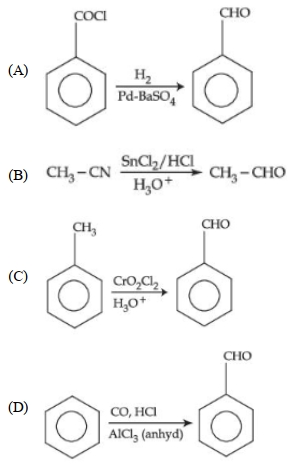
$(I)\,K_3 [Fe(CN_6)]$ $(II)\, [Ni(CO)_4]^0$ $(III)\, [Cr(NH_3)_6]^{3+}$ $(IV)\, [Mn(CN)_6]^{4-}$
Choose the correct code
$ 3 \mathrm{ROH}+\mathrm{PCl}_3 \rightarrow 3 \mathrm{RCl}+\mathrm{A} $
$ \mathrm{ROH}+\mathrm{PCl}_5 \rightarrow \mathrm{RCl}+\mathrm{HCl}+\mathrm{B}$
According the Werner's theory.
$(1)$ Ligands are connected to the metal ions by covalent bonds.
$(2)$ Secondary valencies have directional properties
$(3)$ Secondary valencies are non-ionisable
Of these statements :