MCQ
$EAN$ of $Fe$ in $[Fe(C_2O_4)_3]^{3-}$
  • $27$
  • B
    $24$
  • C
    $35$
  • D
    $29$

Answer

Correct option: A.
$27$
a
In $\left[ Co \left( NH _{3}\right)_{5} CO _{3}\right] ClO _{4}$, five ammonia ligands and one carbonate ligand is attached to the central cobalt atom. Hence, the coordination number is six.

Let $X$ be the oxidation number of cobalt. $X+(-2)+(-1)=0$ or $X=3 .$ Hence, the oxidation number is 3 .

The outer electronic configuration of cobalt (atomic number 27 ) is $3 d^{7} 4 s^{2} .$ The outer electronic configuration of $Co ^{+3}$ will be $3 d^{6} 4 s^{0} .$ Thus it contains six d electrons.

$\left[ Co \left( NH _{3}\right)_{5} CO _{3}\right] ClO _{4}$ is inner orbital or low spin complexes. all the electrons are paired due to $d^{2} s p^{3}$ hybridization of $C o^{+3}$ ion. Hence, the number of unpaired d electrons is zero.

Need a full question paper?

Generate a complete, print-ready paper with questions like this in minutes — across 16+ boards, with answer keys.

Start Generating Free

Similar questions

Lactose on hydrolysis gives
$\begin{matrix}
   O\,\,\,\,\,\,\,\,\,\,\,\,\,\,\,\,\,\,\,\,\,\,\,\,\,\,\,\,\,\,\,\,\,\,\,\,\,\,\,\,\,\,\,\,\,\,\,\,\,\,\,  \\
   ||\,\,\,\,\,\,\,\,\,\,\,\,\,\,\,\,\,\,\,\,\,\,\,\,\,\,\,\,\,\,\,\,\,\,\,\,\,\,\,\,\,\,\,\,\,\,\,\,\,\,\,\,  \\
   R-C-O-R'+R''OH\overset{{{H}^{\oplus }}}{\longleftrightarrow}  \\
\end{matrix}\begin{matrix}
   O\,\,\,\,\,\,\,\,\,\,\,\,\,\,\,\,\,\,\,\,\,\,\,\,\,\,\,\,\,\,\,\,\,\,\,\,  \\
   ||\,\,\,\,\,\,\,\,\,\,\,\,\,\,\,\,\,\,\,\,\,\,\,\,\,\,\,\,\,\,\,\,\,\,\,\,  \\
   R-C-O-R''-R'OH  \\
\end{matrix}$

Above reaction is/an example of

Colour of $Fe^{2+}$ ions is:
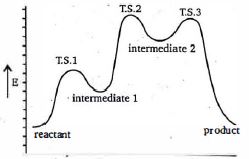
Transition state $2$ is structurally most likely as
For $Zn - Cu$ cell, $E ^{\circ}=1.10 V$. If the reduction potential $\left[ Cu ^{2+}{ }_{( aq )} / Cu _{( s )}\right]$ pair is 0.34 V , then the reduction potential of $\left[ Zn ^{2+}{ }_{(a q)} / Zn _{( s )}\right]$ pair will be :
$A \xrightarrow[\begin{smallmatrix} \left( ii \right)C{{N}^{-}} \\ (iii){{H}_{2}}O/{{H}^{+}} \end{smallmatrix}]{\left( 1 \right)C{{l}_{2}},\Delta }$ $4-$Bromophenyl acetic acid.

In the above reaction $'A'$ is ....

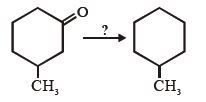
Which of the reducing reagent will be suitable for following conversion ?
The factors affecting corrosion are
An unknown compound ‘$D’,$  first oxidised to aldehyde and then acitic acid by a dilute solution of${K_2}C{r_2}{O_7}$ and ${H_2}S{O_4}$. The unknown compound $‘D$’ is
If the half cell reaction $A + {e^ - } \to \,{A^ - }$ has a large negative reduction potential, it follows that