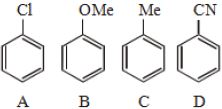
MCQ
$EAN$ of $Mg$ is ... in $[Mg(EDTA)]^{2-}$
- A$16$
- B$20$
- ✓$22$
- D$18$
Atomic no. of $Fe =26$
Oxidation no. of Fe in the given compound is $=3$
Coordination no. $=6$
E.A.N. $=26-3+2 \times 6=35$.
Generate a complete, print-ready paper with questions like this in minutes — across 16+ boards, with answer keys.
$(a) ClO_4^-> ClO_3^-> ClO_2^-> ClO^-$ Stability order
$(b) Cl_2 > Br_2> F_2> I_2$ Bond energy
$(c) OF_2 < OH_2< OCl_2$ Bond angle
$(d) I^-> Br^-> Cl^-$ Reducing power
| List-I (Test) | List-II (Identification) | ||
| (A) | Bayer's test | (I) | Phenol |
| (B) | Ceric ammonium nitrate test | (II) | Aldehyde |
| (C) | Phthalein dye test | (III) | Alcoholic-OH group |
| (D) | Schiff's test | (IV) | Unsaturation |
if $T_1 < T_2$ then $X$ and $Y$ respectively are
$(I)$ It is easier to remove $2 \mathrm{p}$ electron than $2 \mathrm{s}$ electron
$(II)$ $2 \mathrm{p}$ electron of $\mathrm{B}$ is more shielded from the nucleus by the inner core of electrons than the $2 s$ electrons of $Be.$
$(III)\; 2 s$ electron has more penetration power than $2 \mathrm{p}$ electron.
$(IV)$ atomic radius of $\mathrm{B}$ is more than $\mathrm{Be}$
(Atomic number $\mathrm{B}=5, \mathrm{Be}=4$ )
The correct statements are