MCQ
Eels are able to generate current with biological cells called electroplaques. The electroplaques in an eel are arranged in 100 rows, each row stretching horizontally along the body of the fish containing 5000 electroplaques. The arrangement is suggestively shown below. Each electroplaques has an emf of 0.15 V and internal resistance of 0.25 W
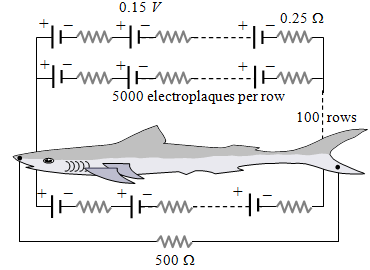


The water surrounding the eel completes a circuit between the head and its tail. If the water surrounding it has a resistance of 500 W, the current an eel can produce in water is about
  • 1.5 A
  • B
    3.0 A
  • C
    15 A
  • D
    30 A

Answer

Correct option: A.
1.5 A
(a) 1.5 A

Need a full question paper?

Generate a complete, print-ready paper with questions like this in minutes — across 16+ boards, with answer keys.

Start Generating Free

Similar questions

The graph that correctly represents the relation of frequency $v$ of a particular characteristic $X-$ ray with the atomic number $Z$ of the material is
Kirchoff’s first law, i.e., $S i = 0$ at a junction, deals with the conservation of:
A resistance of $20$ ohms is connected to a source of an alternating potential $V = 220\,sin\,(100\,\pi t)$. The time taken by the current to change from its peak value to r.m.s value is
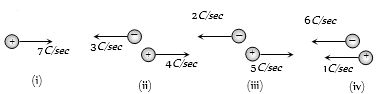
Following figure shows four situations in which positive and negative charges moves horizontally through a region and gives the rate at which each charge moves. Rank the situations according to the effective current through the region greatest first
An electric bulb illuminates a plane surface. The intensity of illumination on the surface at a point $2m$ away from the bulb is $5 \times {10^{ - 4}}$ $phot$ ($lumen/cm^2$). The line joining the bulb to the point makes an angle of $60^{o}$ with the normal to the surface. The intensity of the bulb in candela is
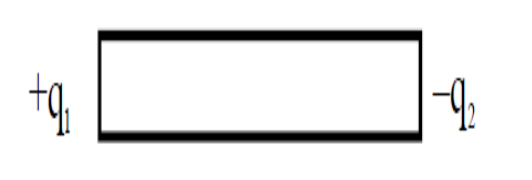
A thin insulator rod is placed between two unlike point charges $+q_1$ and $q_2$. For this situation tick the correct alternative (s):
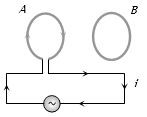
Two circular coils $A$ and $B$ are facing each other as shown in figure. The current $i$ through A can be altered
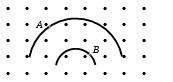
Two particles $A$ and $B$ of masses ${m_A}$ and ${m_B}$ respectively and having the same charge are moving in a plane. A uniform magnetic field exists perpendicular to this plane. The speeds of the particles are ${v_A}$ and ${v_B}$ respectively, and the trajectories are as shown in the figure. Then
A photosensitive substance emits $........$ when illuminated by light:
A particle having the same charge as of electron moves in a circular path of radius $0.5
\,cm$ under the influence of a magnetic field of $0.5\,T.$ If an electric field of $100\,V/m$ makes it to move in a straight path, then the mass of the particle is (given charge of electron $= 1.6 \times 10^{-19}\, C$ )