MCQ
Effective capacitance between $A$ and $B$ in the figure shown is $($all capacitance are in $mF)$
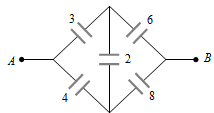
  • A
    $21\ mF$
  • B
    $23\ mF$
  • C
    $\frac{3}{14} \mu F$
  • $\frac{14}{3} \mu F$ 

Answer

Correct option: D.
$\frac{14}{3} \mu F$ 

Need a full question paper?

Generate a complete, print-ready paper with questions like this in minutes — across 16+ boards, with answer keys.
Start Generating Free

Similar questions

A) Line spectra is due to atoms in gaseous state:
B) Band spectra is due to molecules:
A parallel combination of two resistors, of $1\Omega$ each, is connected in series with a $1.5\Omega$ resistor. The total combination is connected across a $10\ V$ battery. The current flowing in the circuit is
An ammeter whose resistance is 180 Ω gives full scale deflection when current is 2 mA. The shunt required to convert it into an ammeter reading 20 mA (in ohms) is(a) 18(b) 20(c) 0.1(d) 10
       
In a sensitive Wheatstone bridge, current in the galvanometer in the state of slight deflection from the position of balance is:
The potential difference between the two plates of a parallel plate capacitor is constant. When air between the plates is replaced by dielectric material, the electric field intensity:
A vector $\overrightarrow{\text{A}}$ points vertically upward and $\overrightarrow{\text{B}}$ points towards north. The vector product $\overrightarrow{\text{A}}\times\overrightarrow{\text{B}}$ is:
  1. Along west.
  2. Along east.
  3. Zero.
  4. Vertically downward.
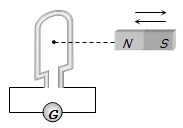
When a magnet is pushed in and out of a circular coil $C$ connected to a very sensitive galvanometer $G$ as shown in the adjoining diagram with a frequency $v,$ then
A current carrying power line carries current from west to east. Then the direction of the magnetic field 2m above it is:
The resistance of a galvanometer coil is $R$. What is the shunt resistance required to convert it into an ammeter of range $4$ times
10cm is a wavelength corresponding to the spectrum of: