MCQ
Einstein was awarded Noble prize for:
  • A
    The general theory of relativity
  • B
    The special theory of relativity
  • The explanation of photoelectric effect
  • D
    The explanation of quantum theory

Answer

Correct option: C.
The explanation of photoelectric effect

Einstein proposed the special theory of relativity and the general theory of relativity. Also, he gave a explanation to quantum theory. According to Nobel committee other theories were in controversy.
The classical theory could not explain photoelectric effect satisfactorily. The photoelectric equation given by Einstein explains photoelectric effect satisfactorily.
Hence, Einstein was awarded Noble prize for the explanation of photoelectric effect.

Need a full question paper?

Generate a complete, print-ready paper with questions like this in minutes — across 16+ boards, with answer keys.
Start Generating Free

Similar questions

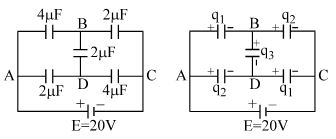
The value of charge $q_1, q_2$ and $q_3$ as shown in the figure are
The quantity $\frac{\text{PV}}{\text{kT}}$ represents:
The diameter of the objective lens of a telescope is $5.0\, m$ and wavelength of light is $6000 Å$. The limit of resolution of this telescope will be......$sec$
A square loop of area $25\,cm ^2$ has a resistance of $10\,\Omega$. The loop is placed in uniform magnetic field of magnitude $40.0 T$. The plane of loop is perpendicular to the magnetic field. The work done in pulling the loop out of the magnetic field slowly and uniformly in $1.0 sec$, will be $..........\times 10^{-3}$
A short bar magnet placed with its axis at $ 30° $ with a uniform external magnetic field of $0.16 $ $Tesla$ experiences a torque of magnitude $0.032$ $Joule$. The magnetic moment of the bar magnet will be......$Joule/Tesla$
The magnetic potential at a point on the axial line of a bar magnet of dipole moment $M$ is $V$. What is the magnetic potential due to a bar magnet of dipole moment $\frac{M}{4}$ at the same point
The time constant of an LR circuit represents the time in which the current in the circuit
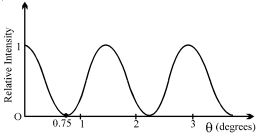
Light of wavelength $520\, nm$ passing through a double slit, produces interference pattern of relative intensity versus deflection angle $\theta$ as shown in the figure. The separation $d$ between the slits is
If the angular momentum of an electron is $\overrightarrow {J\,} $ then the magnitude of the magnetic moment will be
Inside $a$ super conducting ring six identical resistors each of resistance $R$ are connected as shown in figure. The equivalent resistance $(s)$